
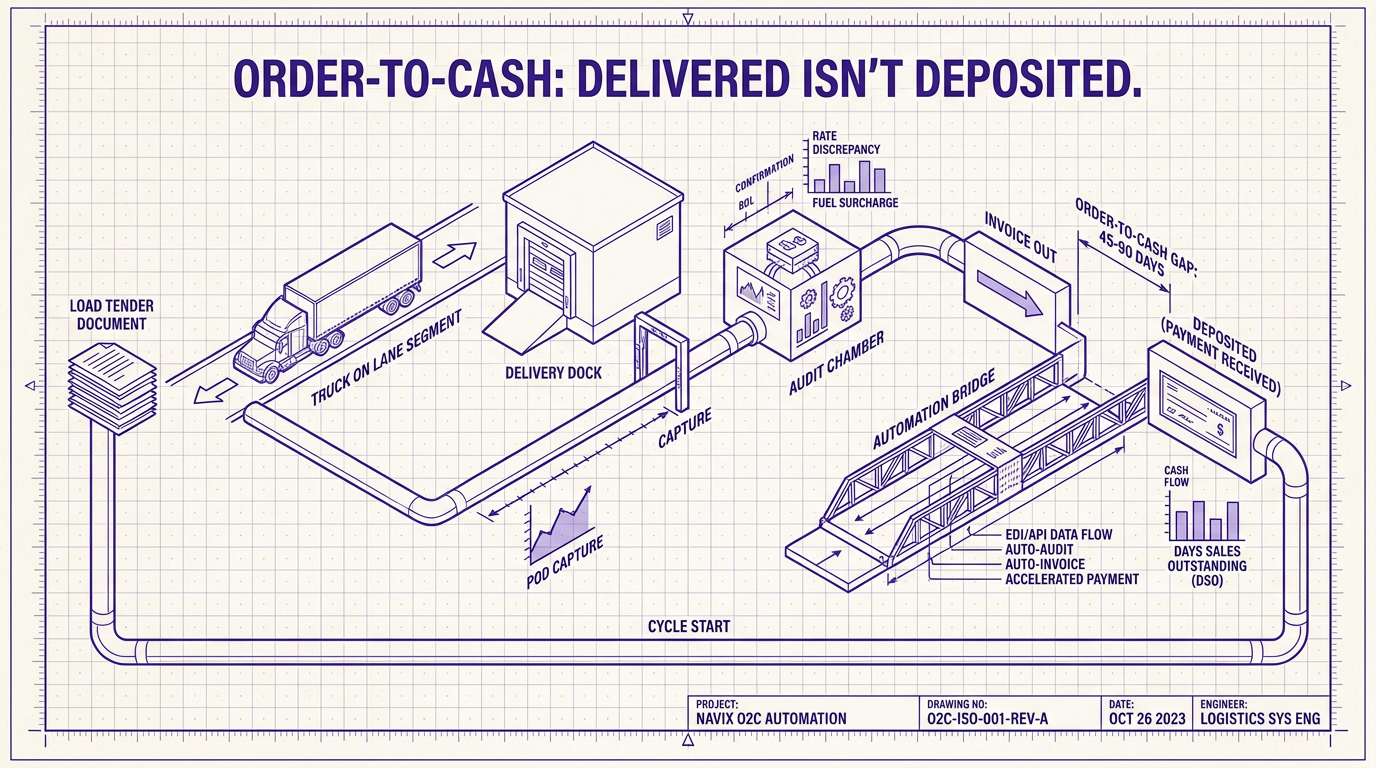
Order-to-cash automation in logistics connects every step between a delivered load and settled money — document collection, freight audit, customer invoicing, payment application, and carrier pay — into one continuous flow. For brokers and 3PLs, the O2C cycle runs through more handoffs than almost any other industry’s, and each handoff is a place where cash slows down or leaks out. Automation closes the loop by removing the waiting rooms between stages.
What are the stages of order-to-cash for a broker or 3PL?
The cycle for a single load runs through six stages:
- Load delivered. The freight arrives; revenue is earned but entirely undocumented.
- Documents collected. POD, BOL, weight tickets, and accessorial backup are gathered from the carrier.
- Invoice audited. The carrier invoice is reconciled against the quoted rate and accessorials are validated, so the customer invoice is built on verified cost.
- Invoice sent. The customer invoice, with documentation attached, reaches the customer’s AP system.
- Payment received. Cash arrives and is applied to the right invoice.
- Carrier paid. The carrier is settled on their terms, closing the loop on the load.
Each stage is simple. The cash problems live in the joints between them.
Where does cash leak at each joint?
Delivered but undocumented. A delivered load with no POD is revenue that cannot be billed. When document chasing is a billing clerk’s side task, loads sit in this state for days, and days-to-bill inflates before anyone touches an invoice.
Documented but unaudited. If the carrier invoice never gets reconciled against the quote, overcharges pass straight through to cost — a duplicated accessorial, a rate applied off the wrong lane, a reweigh with no ticket behind it. Billing the customer from unverified cost either leaks margin or triggers the next leak.
Audited but unbilled. Weekly billing batches park finished invoices in a queue. Every day in that queue is DSO the brokerage chose. The mechanics of closing this gap are covered in how KCH Transportation cut DSO from 39 to 28 days.
Billed but disputed. An invoice with a rate mismatch or missing POD comes back as a short-pay or a dispute, and the receivable ages for weeks while emails go back and forth. Disputes are the most expensive joint in the cycle because they consume both cash time and staff time.
Paid but unapplied. Payments that arrive without clean remittance data sit unapplied, understating cash position and occasionally triggering collection calls on invoices that were already paid.
Collected but unsettled. Slow, opaque carrier pay damages the relationships the brokerage depends on, and carriers price unreliability into the next rate.
What does automation actually compress?
Automation attacks the joints, not the stages. Document collection runs the moment a load delivers, so stage two starts without a human trigger. Pre-bill audit validates every carrier invoice as it arrives, so billing is built on verified cost and disputes are prevented rather than resolved. Invoicing fires the day the audit clears, killing the batch queue. Clean, documented invoices get paid on terms, and settlement data flows through to carrier pay. The whole loop — delivery to settlement — stops depending on anyone remembering to push it forward. That is the model behind the Navix freight audit software, applied across the broker, 3PL, and shipper configurations on the solutions page.
The staffing effect is the part most operators underestimate. Axle Logistics reallocated half its billing team after automating its audit-to-invoice flow and went on to grow roughly 300% — the same people, moved from document chasing to work that scales. The detail is in the Axle Logistics case study.
FAQ
What is order-to-cash in logistics?
Order-to-cash (O2C) is the full cycle from a delivered load to settled cash: documents collected, carrier invoice audited, customer invoice sent, payment received and applied, carrier paid. It spans billing, receivables, and payables on every single load, which is why small per-load delays compound into serious working-capital drag.
Which O2C stage should a brokerage automate first?
The audit-and-billing joint, because it controls both margin and DSO. Automating document collection and pre-bill audit means invoices go out fast and correct, which prevents the disputes that make every downstream stage slower. Collections automation applied to flawed invoices just chases problems faster.
How is O2C automation different from just having a TMS?
A TMS manages the operational life of a load — tender, dispatch, track, deliver. O2C automation manages the financial life of the load after delivery, which most TMS platforms treat as an export. The audit, invoicing, and settlement layer sits between the TMS and the accounting system, connected to both.
Does O2C automation replace the billing team?
It replaces the queue-clearing portion of the work. Axle Logistics kept its people and redeployed half of the billing team onto customer-facing and growth work while volume roughly quadrupled. Headcount stopped scaling with load count, which is the economic point.
Find your slowest joint
Pull ten recent loads and timestamp all six stages for each. One joint will dominate the elapsed time, and it is usually delivered-to-billed, the stretch entirely inside the brokerage’s own walls. To see the loop run without the waiting rooms, book a demo with Navix.