
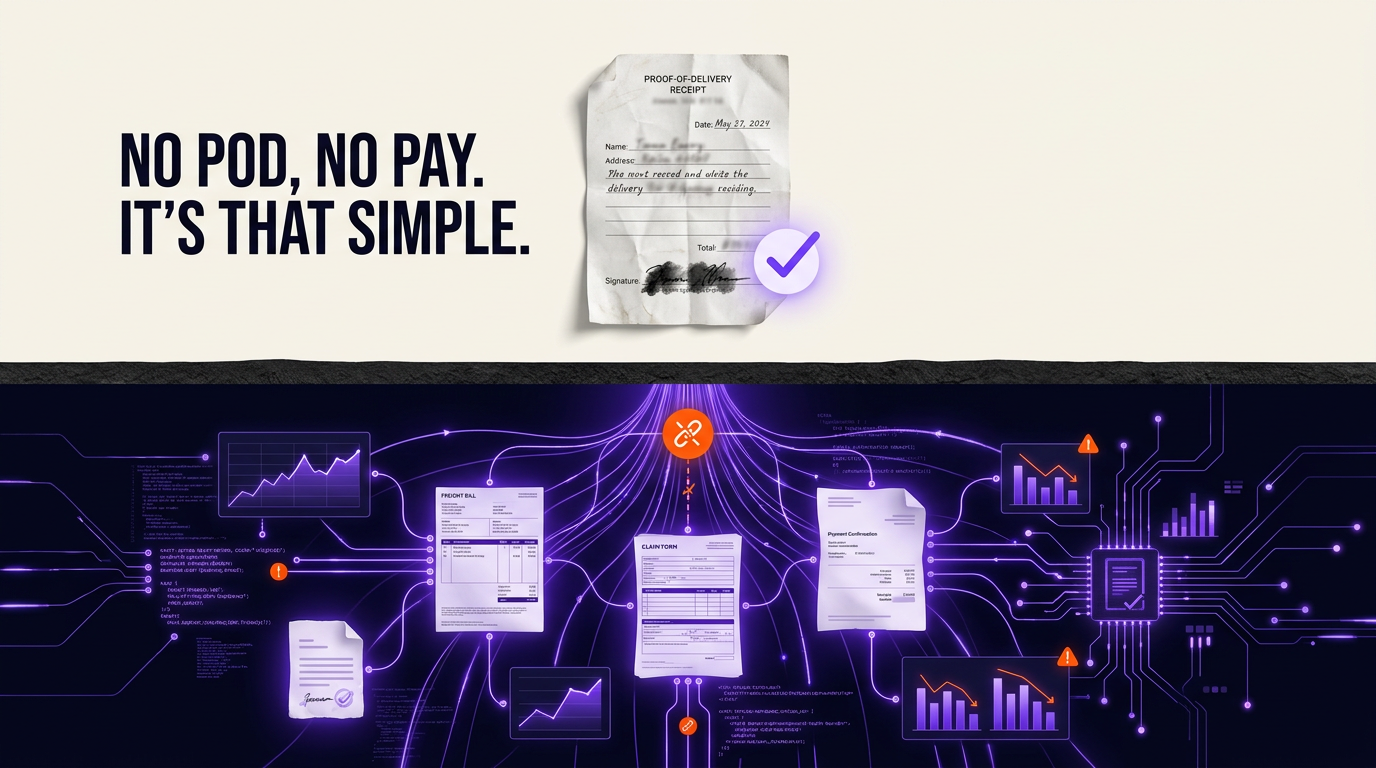
Proof of delivery (POD) is a document — signed, stamped, or digital — that confirms a shipment was received by the consignee, including the date, time, delivery location, and the condition of the goods on arrival. In freight, a clean POD is more than a receipt: it is the trigger that lets a 3PL or broker bill accurately, invoice fast, and get paid sooner. Without it, the entire billing chain stalls.
Proof of delivery is the bedrock of operational success for third-party logistics providers (3PLs) and freight brokers. With accurate proof of delivery, carriers and brokers can reconcile shipments, resolve exceptions, and keep billing moving without manual chasing.
What Is Proof of Delivery (POD)?
Proof of delivery (POD) is the documented confirmation that a shipment reached its intended recipient. It captures who received the freight, when and where it was delivered, and whether the goods arrived intact or with visible damage or shortages. A POD closes the loop on a movement — it is the record that says the job was done and that the invoice attached to it is legitimate.
In everyday freight operations, “POD” is used two ways: the physical or electronic document itself, and the proof event that unlocks billing. Both matter. The document defends against claims and disputes; the event starts the clock on getting paid.
What Information Is on a Proof of Delivery?
A complete proof of delivery typically includes:
- The consignee’s name and signature (or an electronic capture) confirming receipt
- The delivery date, time, and location
- A description of the goods, piece count, and weight
- The condition of the freight on arrival, including any noted damage, shortages, or overages (OS&D)
- The carrier, driver, and reference numbers (PRO number, BOL number, PO number)
- Any accessorial or exception notes recorded at delivery
The more complete the POD, the faster it clears billing — and the harder it is for a customer to dispute the invoice later.
BOL vs. POD vs. Signed POD: What’s the Difference?
These three documents are related but distinct, and confusing them is a common source of billing errors.
- A Bill of Lading (BOL) is the contract created when freight is picked up. It states what is being shipped, from where, to where, and under what terms. It is the beginning of the movement.
- A Proof of Delivery (POD) confirms the end of the movement — that the freight arrived and in what condition.
- A signed POD is a POD that carries the consignee’s signature (wet-ink or electronic), which is the strongest evidence for billing and for defending against freight claims.
In short: the BOL says what should happen, and the POD proves what did happen. Billing depends on the POD, not the BOL.
Electronic Proof of Delivery (ePOD): The Modern Standard
Electronic proof of delivery (ePOD) replaces the paper receipt with a digital capture — a signature on a driver’s device, a timestamped photo of the delivered freight, or a scanned document uploaded the moment the truck is unloaded. ePOD removes the delay of physical paperwork moving through the mail or a back office.
For 3PLs and brokers, the advantage is speed and integrity. An ePOD lands in the system in minutes instead of days, it is legible and complete, and it can be matched automatically against the rate and the invoice. That is the difference between billing the same day and billing next week.
How POD Drives Faster Billing and Lower DSO
Every day a POD sits uncollected is a day a broker or 3PL cannot invoice — and a day added to Days Sales Outstanding (DSO), the measure of how long it takes to convert delivered freight into cash. Missing or incomplete PODs are one of the most common and least-discussed drivers of high DSO in freight.
The sequence is simple: clean POD leads to an accurate, dispute-proof invoice, faster customer payment, and a reduced Days Sales Outstanding (DSO). When POD capture is automated and PODs are matched to invoices without manual handling as part of the freight audit and invoicing process, the billing cycle compresses and cash arrives sooner. When POD is a manual scramble, invoices go out late, disputes rise, and working capital gets trapped in accounts receivable.
This is why proof of delivery is not just an operations concern — it is the front end of the accounts receivable process. Getting POD right is the first step to getting paid sooner.
Risks of Incomplete or Missing POD
Incomplete or missing POD documentation isn’t just a minor inconvenience; it carries real risk. Missing proof of delivery drastically reduces the ability to resolve freight claims — to the extent that a claim may be automatically denied by the carrier. It also raises the risk of customer disputes and delayed payments, which can damage both reputation and cash flow when the pattern persists.
From Manual to Automated POD
Manual POD processing is labor-intensive and error-prone. It depends on someone reading another person’s handwriting, keying amounts into spreadsheets, and working through a backlog of receipts — which makes it hard to know current margins in real time. Automated POD solutions use AI and machine learning to automate POD capture and invoicing: data extraction, exception handling, and invoice matching happen in real time, cutting clerical errors and freeing the team from manual entry. Automated POD integrates with Transportation Management Systems (TMS) for real-time tracking and full shipment visibility, and it improves the accuracy and timeliness of billing — reducing disputes and the overhead of manual data entry.
Frequently Asked Questions About Proof of Delivery
What is proof of delivery?
Proof of delivery (POD) is a signed, stamped, or digital document confirming that a shipment was received by the consignee, including the date, time, location, and condition of the goods on arrival. In freight, the POD is the record that authorizes accurate billing.
What does POD mean in shipping and trucking?
In shipping and trucking, POD stands for “proof of delivery.” It is the confirmation that a driver delivered the freight to its destination and that the recipient accepted it. The POD is the evidence used to bill the customer and to defend against freight claims.
What information is on a POD?
A POD typically includes the consignee’s signature, the delivery date, time, and location, a description and count of the goods, the condition of the freight on arrival (including any damage or shortages), and reference numbers such as the PRO, BOL, and PO numbers.
What happens if a POD is missing?
A missing POD stalls billing and weakens the ability to resolve freight claims. Without proof that freight was delivered, invoices are delayed or disputed, cash gets trapped in accounts receivable, and Days Sales Outstanding (DSO) rises. Recovering missing PODs is one of the fastest ways to accelerate cash flow.
How does proof of delivery affect cash flow and DSO?
POD is the trigger for invoicing. A clean POD lets a broker or 3PL bill accurately and immediately, which shortens the payment cycle and lowers DSO. Slow, manual, or missing POD capture does the opposite — it delays invoices and inflates DSO. Faster, automated POD handling is a direct lever on getting paid sooner.
What is electronic proof of delivery (ePOD)?
Electronic proof of delivery (ePOD) is a digital version of the POD — a captured signature, timestamped photo, or scanned document delivered in real time from the point of delivery. ePOD reaches the billing system in minutes rather than days, making invoicing faster and more accurate than paper POD.
Navix is an AI-powered freight audit software that helps 3PLs and freight brokers turn accurate proof of delivery into faster, cleaner billing — so cash arrives sooner.