
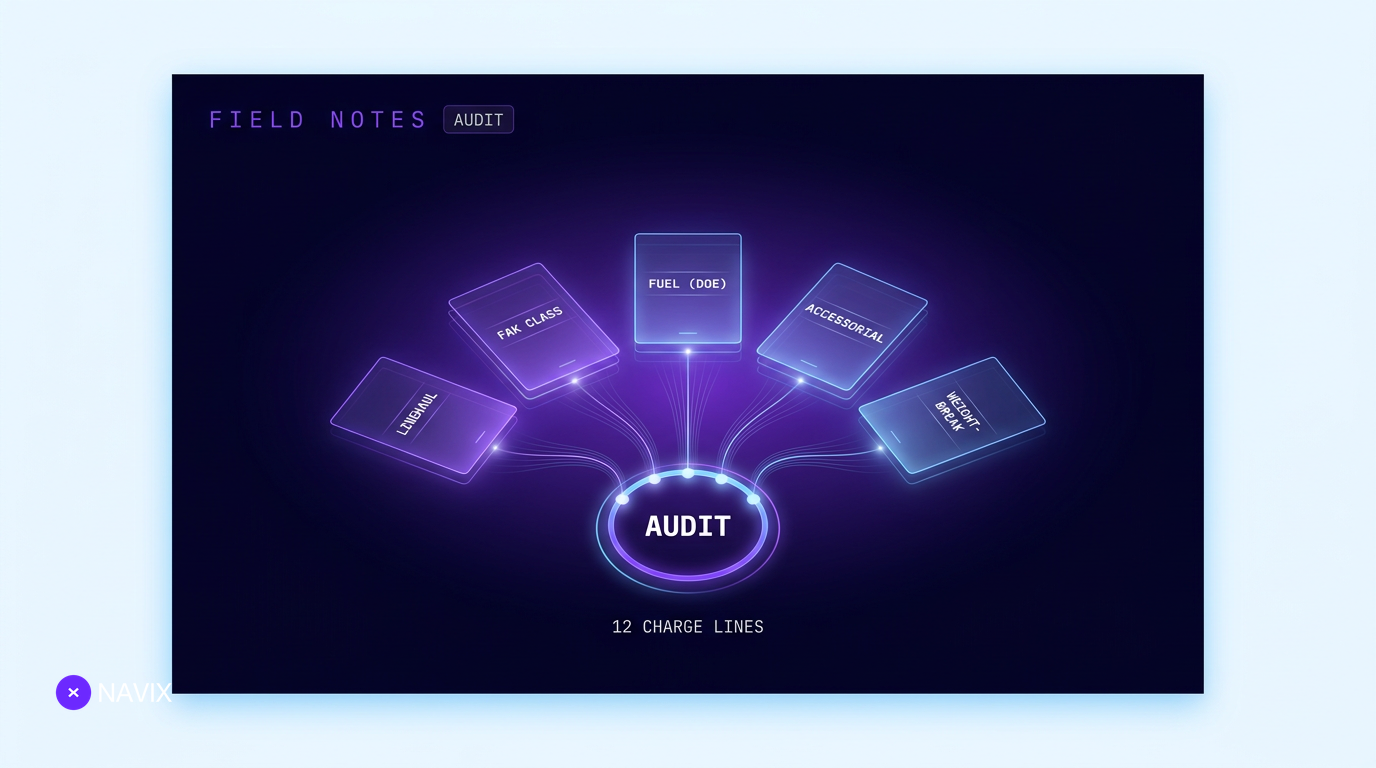
What Is LTL Freight Audit Software?
Answer capsule: LTL freight audit software automates validation of less-than-truckload carrier invoices at the line-item level — checking fuel surcharges, accessorial charges, weight-break pricing, and handling fees against contracted rates before payment is approved.
LTL billing is the most complex invoice type in freight brokerage. A single LTL shipment can generate 8-12 separate charge lines, each calculated from a different rate table, contract term, or published index. Manual audit is labor-intensive, error-prone, and slow — directly increasing DSO for brokers who cannot bill their shipper customers until carrier invoices clear. FTL audit is a simple rate-confirmation match; LTL audit requires validating the calculation methodology behind each charge.
Why Is LTL Auditing More Complex Than FTL?
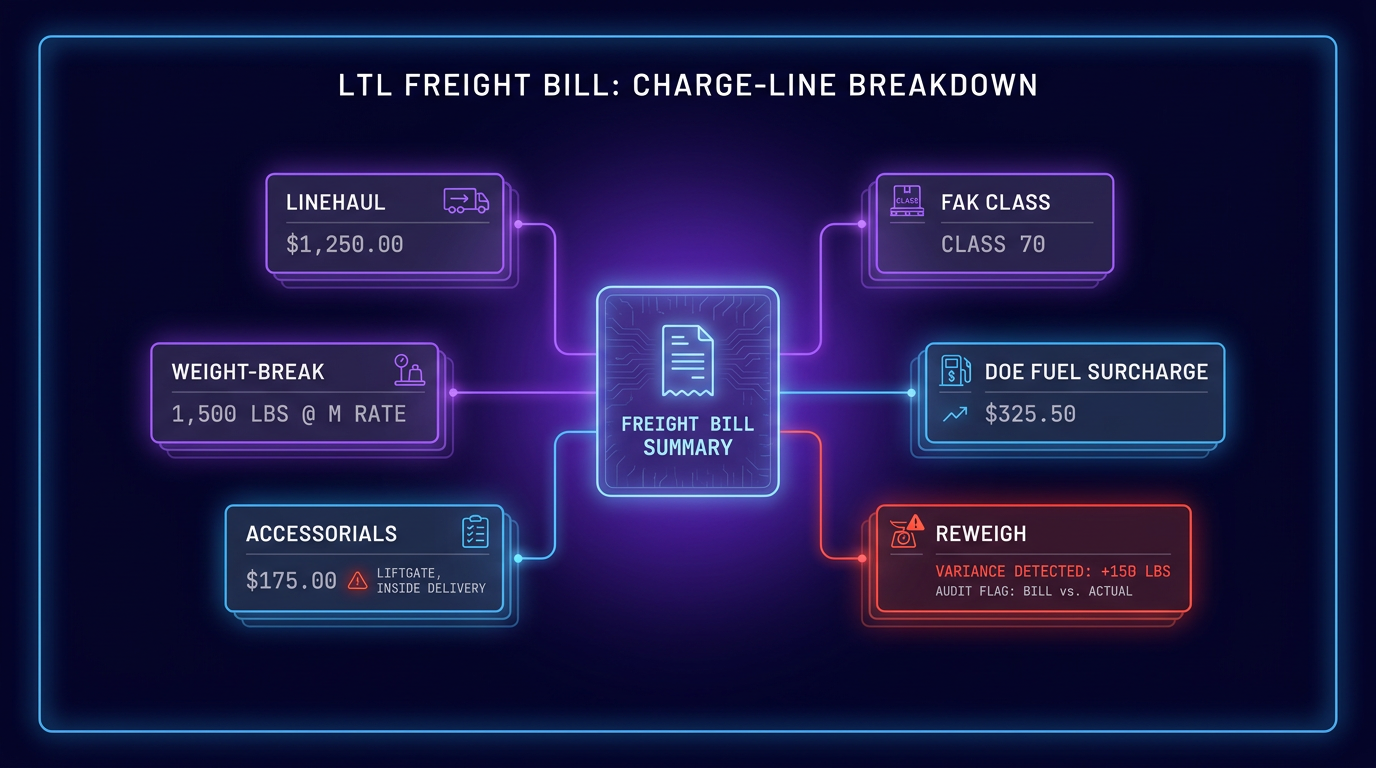
| Charge Type | Validation Required | Frequency of Errors |
|---|---|---|
| Linehaul rate | FAK class, weight-break, deficit weight, minimum charge | High — class misapplication |
| Fuel surcharge | DOE index lookup, contract-specific % table | High — wrong index date |
| Accessorial charges | Liftgate, inside delivery, notify, limited access | Medium — wrong tier applied |
| Handling fees | Per-hundredweight with minimums and caps | Medium — cap exceeded |
| Reweigh charges | Actual vs. billed weight, tolerance thresholds | Low but high dollar |
| Detention/storage | Hourly/daily rates with free-time allowances | Medium — free time ignored |
A broker processing 500 LTL shipments per week at ~4 charge lines each is validating 2,000 individual charges — 67-100 hours of labor weekly, or 2 FTEs doing nothing but checking math.
How Does Navix Approach LTL Freight Auditing?
Answer capsule: Navix uses AI/ML trained on 4+ years of LTL production data to validate every charge component automatically. Passing invoices auto-approve without human review; only exceptions route to staff with root-cause identification.
- Document ingestion — via API, in-house EDI 210, or email. For LTL, Navix also gathers documents directly from top LTL carrier APIs and websites, so the audit doesn’t wait on carriers to push paperwork.
- Intelligent data extraction — IDP extracts every charge line, weight, class, and reference number
- Rate validation — against contracted rate tables, FAK agreements, and minimum-charge rules
- Rating Engine API — connects to your native rating engine to retrieve re-rated costs from the original source, so every charge is checked against the true contracted number rather than a re-keyed copy
- Fuel surcharge audit — calculated independently using the published DOE index for the correct effective date
- Accessorial verification — against shipper-specific contract terms and tier structures
- Auto-approval or exception — clean invoices approved instantly; exceptions flagged with the specific reason
Why the LTL data advantage matters: Navix runs more FTL volume than LTL — but unlike platforms that bolted LTL on in 2026, it has spent 4+ years building LTL-specific production data. Rate pattern recognition improves with history (it knows “normal” per carrier and lane); fuel-surcharge logic is validated across thousands of index cycles; accessorial patterns are modeled per carrier for anomaly detection. By comparison, Transflo launched Workflow AI for LTL in January 2026 — months of data against Navix’s years.
What Results Do Brokers See?
Answer capsule: Navix customers see a minimum 3-day reduction in order-to-cash, and industry benchmarks show automated LTL audit recovers 1-5% of carrier costs.
Navix outcomes: KCH Transportation cut DSO from 39 to 28 days and Days-to-Bill from 8 to 4 after automating customer billing with Navix Pre-Bill. Across the customer base, the minimum order-to-cash improvement is 3 days. Industry benchmarks (CSCMP 2025): automated billing cuts processing time 60-75%; dispute rates fall 40-55%; auditing recovers 1-5% of transportation costs.
For a broker with $50M in annual LTL carrier costs, a 2% recovery rate equals $1M recovered annually — before headcount and DSO effects.
How Does It Integrate?
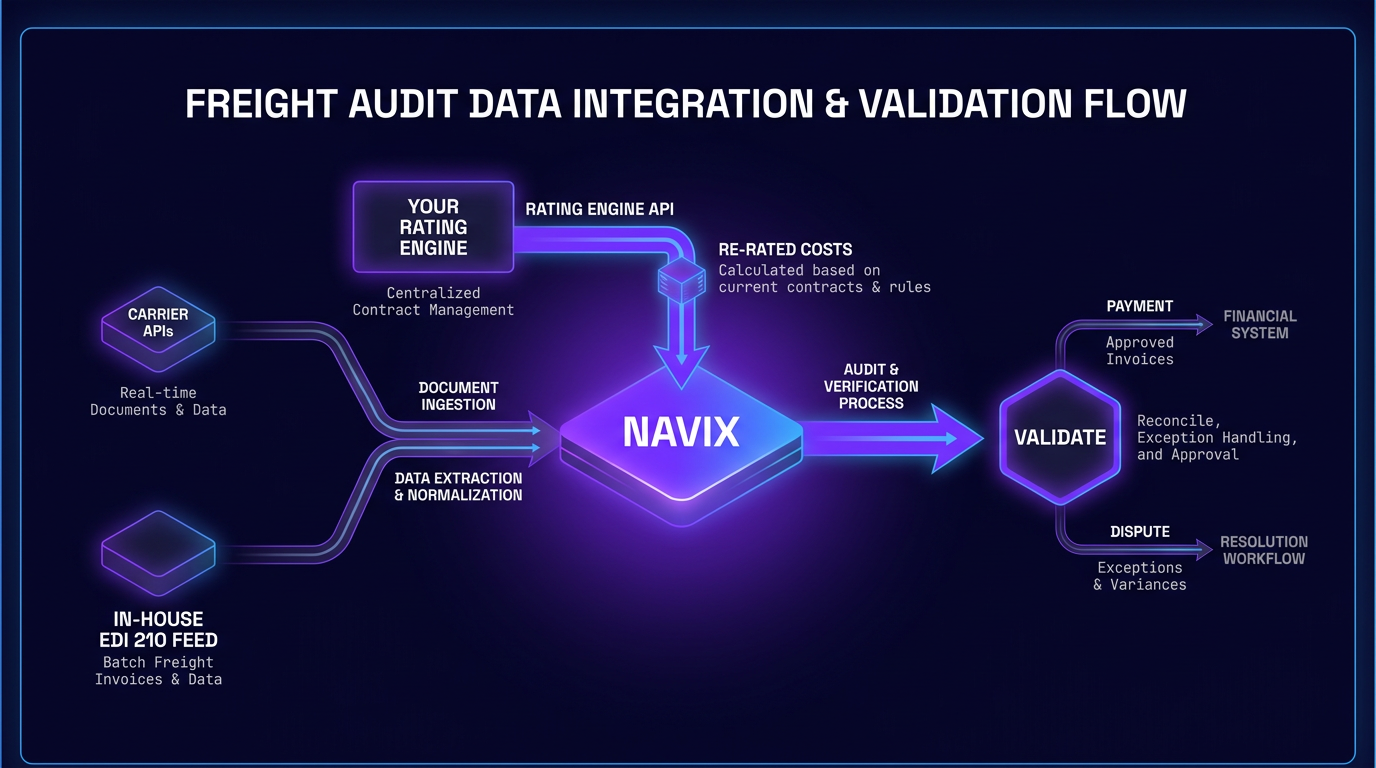
In-house EDI 210 carrier relationships (direct invoice connectivity); the Rating Engine API (re-rated costs pulled from your native rating engine); SMC3 (CzarLite base rates); project44 (shipment tracking); Tai Software (TMS rate/load data); Cleo (EDI orchestration); and major TMS platforms (bidirectional rates and approvals). Brokers don’t change how carriers submit invoices — Navix sits between invoice receipt and payment approval.
Still auditing LTL invoices manually? See how Navix validates every charge line automatically against your own rating engine. Request a demo with your data.