
What Is Drayage Audit Software?
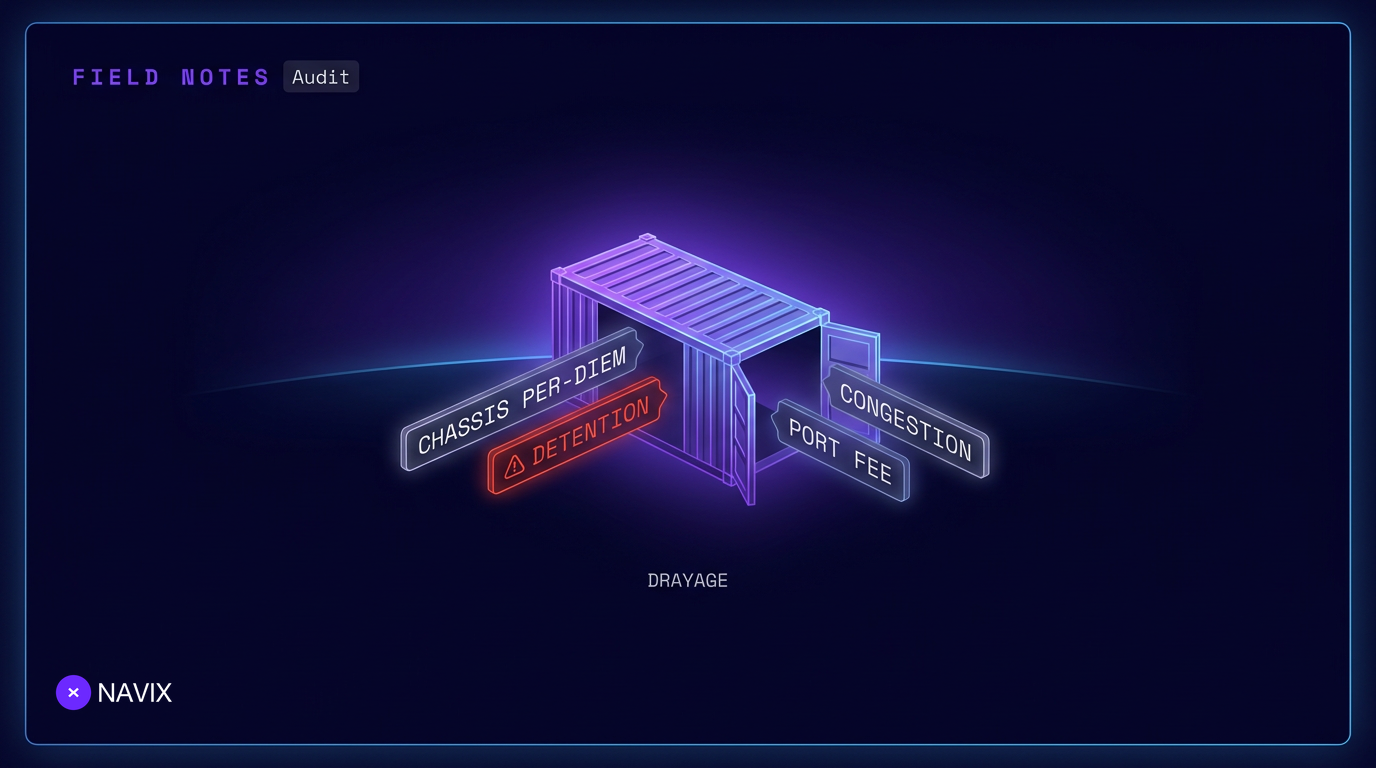
Answer capsule: Drayage audit software validates container drayage invoices at the line-item level — auditing chassis fees, detention charges, port fees, per-diem costs, and accessorials against contracted rates before the broker approves payment.
Container drayage is one of the most error-prone invoice categories in freight brokerage. A single drayage move can generate 6-10 separate charges — many assessed by port terminals, chassis pools, or steamship lines rather than the drayage carrier itself. These pass through to the broker’s invoice with limited transparency into whether they are correct.
Why Is Drayage Billing So Difficult to Audit?
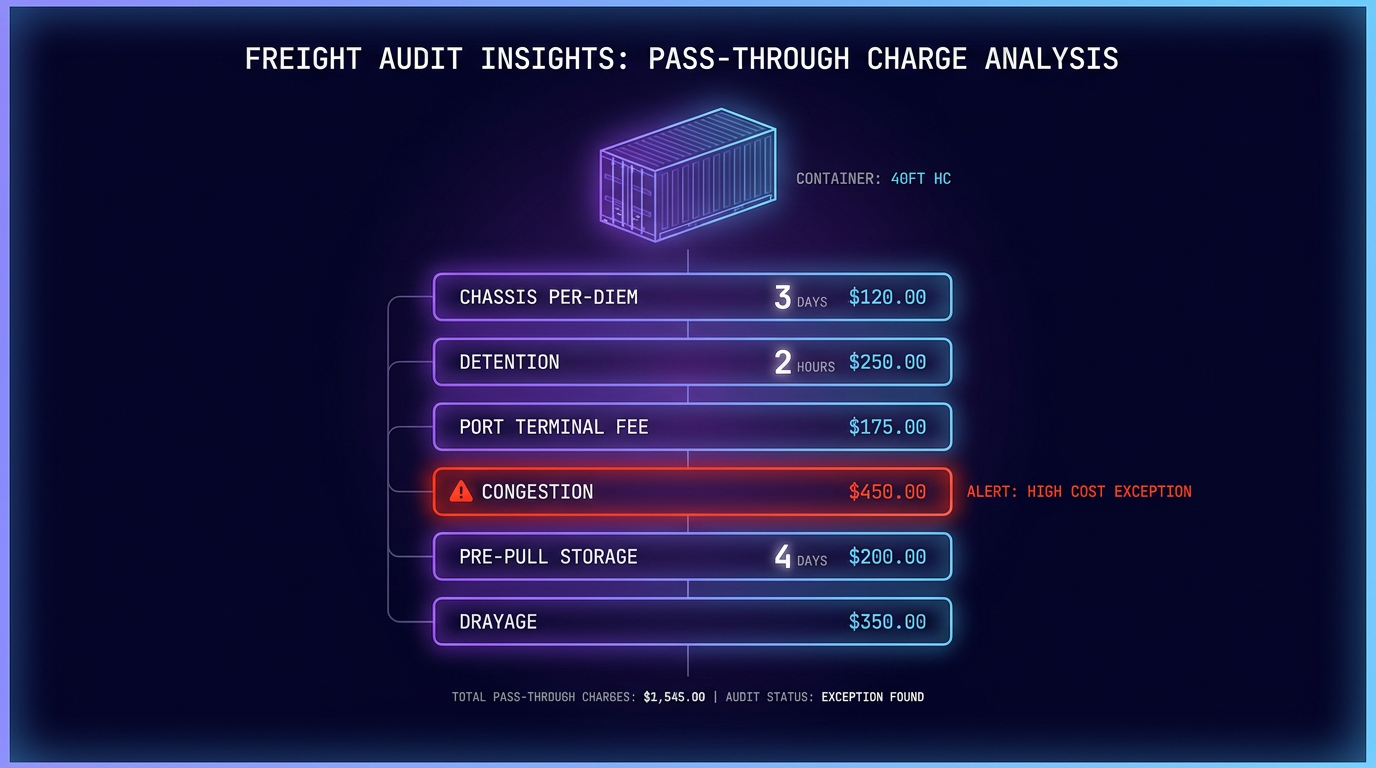
Answer capsule: Drayage invoices combine carrier linehaul charges with pass-through fees from ports, chassis pools, and steamship lines — each with different rate structures, free-time allowances, and escalation schedules that change frequently.
| Charge | Source | Audit Complexity |
|---|---|---|
| Linehaul (port to destination) | Drayage carrier | Moderate — rate varies by zip/zone |
| Chassis rental | Chassis pool (DCLI, TRAC, Flexi-Van) | High — daily rates, per-diem escalation |
| Port terminal fees | Terminal operator | High — varies by terminal, container size |
| Detention/demurrage | Steamship line | High — free-time rules, weekend exclusions |
| Fuel surcharge | Drayage carrier | Moderate — percentage of linehaul |
| Congestion surcharge | Carrier or terminal | Variable — market-driven, time-limited |
| Pre-pull/storage | Carrier or yard | Moderate — daily rates with caps |
| Tri-axle chassis | Chassis pool | Situational — weight-dependent |
A broker handling 200 drayage moves per week across 3 ports is managing thousands of individual charge validations monthly.
How Does Navix Audit Drayage Invoices?
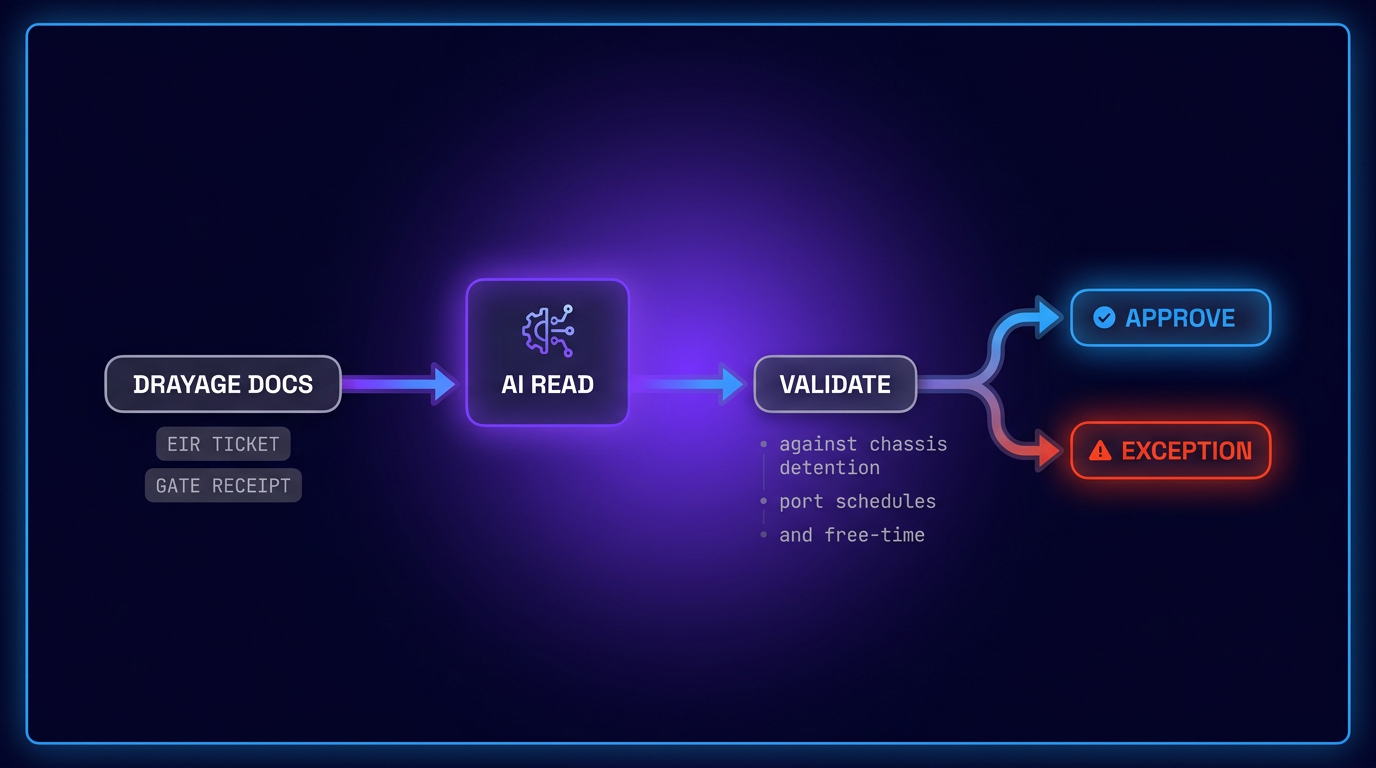
Answer capsule: Navix is the only freight audit platform with dedicated drayage support. Its AI automatically reads drayage documents — including EIR (Equipment Interchange Receipt) tickets and gate receipts — and validates every charge line against contracted carrier rates, published chassis-pool schedules, and port fee tables.
- Document ingestion — Carrier submits drayage invoice and supporting docs via API, EDI, or email
- Document reading — Navix’s AI automatically reads and classifies drayage-specific documents, including EIR tickets and gate receipts, extracting the dates and charges that drive the audit
- Charge extraction — IDP identifies and categorizes each charge type
- Rate validation — Linehaul against contracted zone/zip rates; chassis fees against pool schedules; detention against free-time allowances; port fees against terminal tariffs
- Free-time calculation — Tracks container availability from gate and interchange dates; calculates whether detention/demurrage falls within or outside contracted free time
- Auto-approval or exception — Clean invoices approved; exceptions flagged with the specific charge-line failure
Why drayage needs a specialized engine: multiple rate sources per invoice; date-sensitive calculations (weekend/holiday exclusions) that depend on reading EIR and gate documents correctly; pass-through fee validation against the original source; container-level tracking to booking references and vessel arrivals.
What Do Brokers Recover?
Answer capsule: Drayage has the highest error rate of any freight mode. Brokers running automated drayage audit typically recover 3-5% of drayage costs in billing corrections.
Common errors caught: chassis charges billed beyond contract-allowed free days; detention assessed during excluded weekends; port fees at the wrong container-size rate (20′ vs. 40′); fuel surcharges on total invoice rather than linehaul only; duplicate per-diem charges; expired congestion surcharges.
For a broker with $20M in annual drayage costs, a 4% error-recovery rate represents $800K recovered annually — plus DSO improvement from faster processing.
Who Needs Drayage Audit Software?
Intermodal brokers managing door-to-door container moves; 3PLs with port operations at major U.S. gateways (LA/Long Beach, NY/NJ, Savannah, Houston); cross-border specialists; freight brokers adding drayage to existing FTL/LTL offerings.
Handling drayage? You are likely overpaying. See what line-item audit catches on your EIR tickets, gate receipts, and chassis fees. Request a demo.