
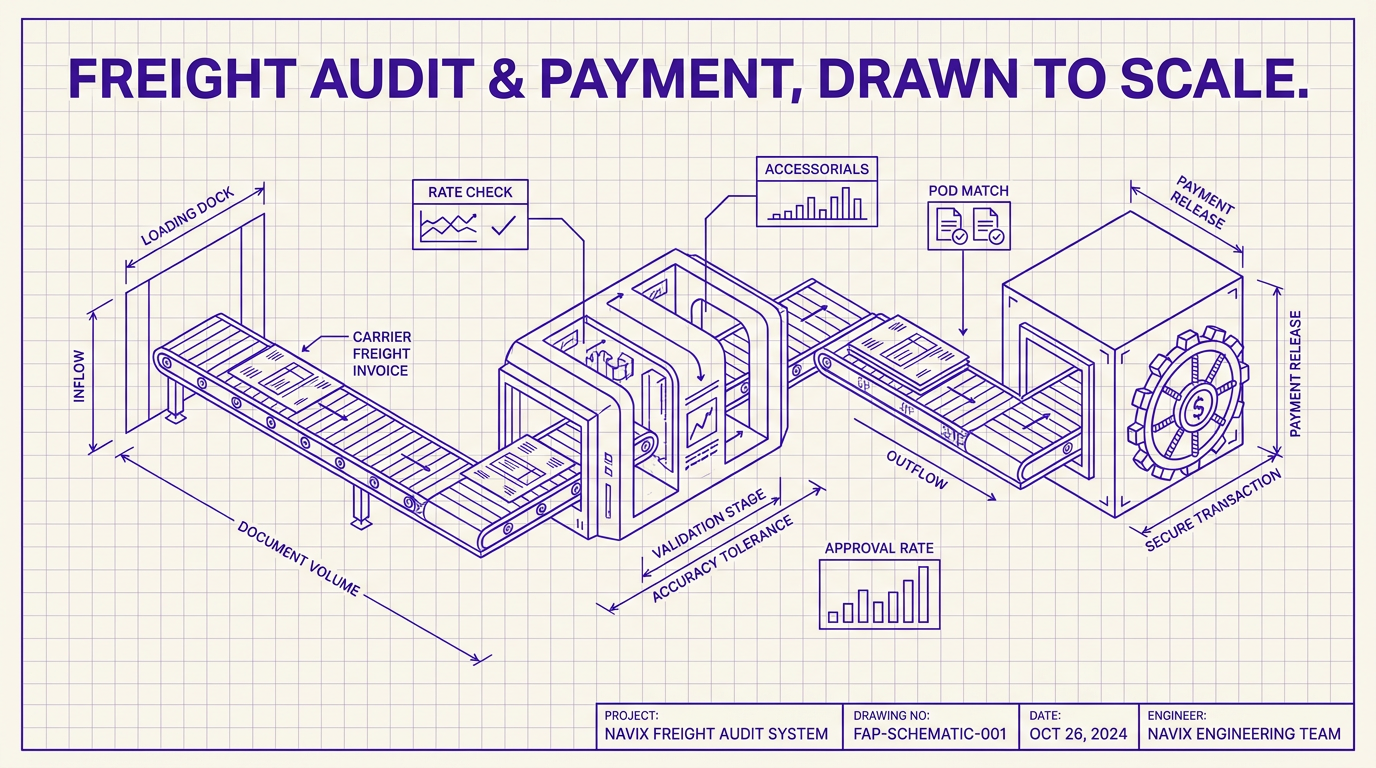
Freight audit and payment (FAP) is the process of verifying that every carrier invoice matches the agreed rate, contract terms, and shipment documentation before the bill gets paid, and then executing payment to the carrier. The audit checks line items like base rates, fuel surcharges, and accessorials against the rate agreement, the BOL, and the POD. Done well, it catches billing errors before money moves and before a customer ever sees a wrong invoice.
For 3PLs and freight brokers, FAP sits in the middle of the cash cycle: a load can’t be billed to the customer until the carrier invoice is verified, so every day an invoice sits in audit is a day added to days-to-bill and, downstream, to DSO.
How does the manual freight audit process work?
At most brokerages, the manual version looks like this: a carrier invoice arrives by email or portal. A billing clerk pulls up the load in the TMS, finds the rate confirmation, and compares the invoiced amount to the contracted rate. If there’s an accessorial (detention, a lumper fee, a reweigh), the clerk hunts for supporting documentation: timestamps on the POD, a lumper receipt, a corrected weight ticket. If anything is off, the invoice goes into a dispute queue and waits for the carrier to respond.
Two problems compound at scale. First, throughput: a clerk can only work so many invoices per day, so growing load volume means growing headcount. Second, coverage: when volume outruns staff, teams fall back to spot checks and dollar thresholds, which means most invoices get paid without a real line-item review. Errors below the threshold sail through, and margin leaks one accessorial at a time.
Automated audit inverts this. Software extracts the invoice data, matches it to the load, and checks every line item against the rate agreement automatically, flagging only true exceptions for a human. The Navix platform runs this model across TL, LTL, and drayage, where accessorial density makes manual review hardest.
Pre-bill audit vs. post-audit: what’s the difference?
The timing of the audit determines what it can actually fix.
Post-audit reviews invoices after payment, typically to recover overcharges. It claws back money already lost and does nothing for the customer invoice that already went out wrong.
Pre-payment audit verifies the carrier invoice before the carrier gets paid. Overcharges get disputed instead of recovered, which is better, but the customer-facing invoice may still be waiting on the audit to clear.
Pre-bill audit goes one step earlier: the carrier charges are verified before the invoice to the customer is generated. For a broker or 3PL, this is the version that touches cash flow, because it compresses days-to-bill. Navix Pre-Bill works this way — audit first, then bill — which is how KCH Transportation cut DSO from 39 days to 28 days. Eleven days of receivables timing recovered by moving the audit ahead of the customer invoice.
What does a line-item freight audit check?
A complete audit verifies each charge on the invoice, not just the total:
- Base rate against the rate confirmation or contract tariff for the lane
- Fuel surcharge against the agreed index and schedule
- Accessorials (detention, liftgate, reweigh, redelivery, layover) against the agreement and against documentation proving the event occurred
- Reweigh and reclassification against the original BOL weight and freight class
- Duplicate billing: the same load invoiced twice under different invoice numbers
- Arithmetic: line items that don’t sum to the invoice total
- POD match: confirmation the load actually delivered as billed
Each check is simple. The reason they don’t happen consistently is volume: at thousands of invoices a month, only automation reviews every line on every invoice.
Why does freight audit matter for cash flow?
Because the audit gates billing. A brokerage that takes eight days to verify carrier charges takes at least eight days to invoice its customer, and DSO inherits every one of those days. Slow audit also ties up the billing team in low-value document matching, work that scales linearly with load count. Axle Logistics reallocated half of its billing team after automating audit with Navix, and grew roughly 300% without rebuilding that team around invoice review.
There’s also a trust dimension: billing errors that reach customers create disputes, credit memos, and slower payment on everything else. Auditing before billing keeps those errors internal.
For teams evaluating vendors, the freight audit software comparison guide breaks down what separates a true line-item audit platform from a payment processor with an audit checkbox — a distinction that matters when comparing Navix against payment-first tools like TriumphPay or ePay Manager. And because FAP platforms handle rate agreements and payment data, security posture belongs in the evaluation: Navix is SOC 2 Type II attested against the Security criteria of the AICPA Trust Services Criteria.
FAQ
What is freight audit and payment in simple terms?
It is the verification of carrier invoices against contracted rates and shipping documents (BOL, POD, rate confirmation), followed by payment of the corrected amount. The audit catches overcharges, duplicates, and unsupported accessorials before money leaves the building.
What is the difference between freight audit and freight payment?
The audit is the verification step: checking each line item against the agreement and the documentation. Payment is the settlement step: funding the carrier once charges are verified. Many providers bundle both, but the audit is where errors are caught and margin is protected; payment is execution.
Who needs freight audit and payment?
Any organization paying carrier invoices at volume: freight brokers, 3PLs, and shippers. Brokers and 3PLs have the added stake that carrier invoice verification gates their own customer billing, so audit speed directly moves DSO.
Is pre-bill audit better than post-audit?
For brokers and 3PLs, yes. Post-audit recovers money after the fact; pre-bill audit prevents the error from reaching the customer invoice at all and shortens days-to-bill. Recovery is a consolation prize compared to billing correctly and quickly the first time.
Audit every invoice before it bills, and DSO stops being a finance problem and starts being a settings choice. Book a demo to see Navix Pre-Bill on live freight.