
Top Freight Audit
Companies Compared (2026)
Freight audit companies verify carrier invoices against contracted
rates and shipment records, catching duplicate billing, misapplied
accessorials, reweighs, and fuel surcharge errors before they become
overpayments. The market splits into three groups: legacy freight audit
and payment (FAP) outsourcers, AI-native audit platforms, and
payment-first networks. The right pick depends on who is buying (an
enterprise shipper versus a 3PL or freight broker) and whether errors
get caught before or after money moves.
What do freight
audit companies actually do?
Every carrier invoice is a claim: this load, this lane, this rate,
these accessorials. A freight audit checks that claim against the rate
agreement, the BOL, and the delivery record. At a few hundred loads a
month, a billing clerk can keep up. At thousands, manual review either
slows billing to a crawl or waves errors through. Freight audit
companies industrialize that check, but they structure it in three very
different ways, and the structure matters more than any feature
list.
Who
are the legacy freight audit and payment outsourcers?
Cass
Information Systems, CTSI-Global, Trax Technologies, and nVision Global anchor
this bucket. The model is a service bureau: carriers route invoices to
the provider, the provider audits them, and in most cases pays carriers
on the client’s behalf. Cass has operated for decades and runs payments
through its own bank subsidiary. CTSI-Global pairs its audit service
with a native TMS. Trax positions around transportation spend management
for global shippers and logistics service providers. nVision Global
audits across road, rail, air, and ocean.
These firms earned their position honestly. They handle global,
multi-modal complexity that few software startups have touched. The
tradeoff is structural: the model was built for enterprise shippers
managing spend, the audit is post-invoice by design, and the cycle runs
on the provider’s cadence. A freight broker whose real problem is
billing customers fast gets little help from a service bureau built to
pay a shipper’s carriers.
What are AI-native
freight audit platforms?
The second bucket is software: platforms that read carrier invoices
line by line with AI and audit them in hours instead of weeks. OpenEnvoy
applies real-time AI audit against contracts and sits close to the
finance team’s AP workflow. Loop
positions as an audit and payment platform for shippers, using AI to
compress invoice review.
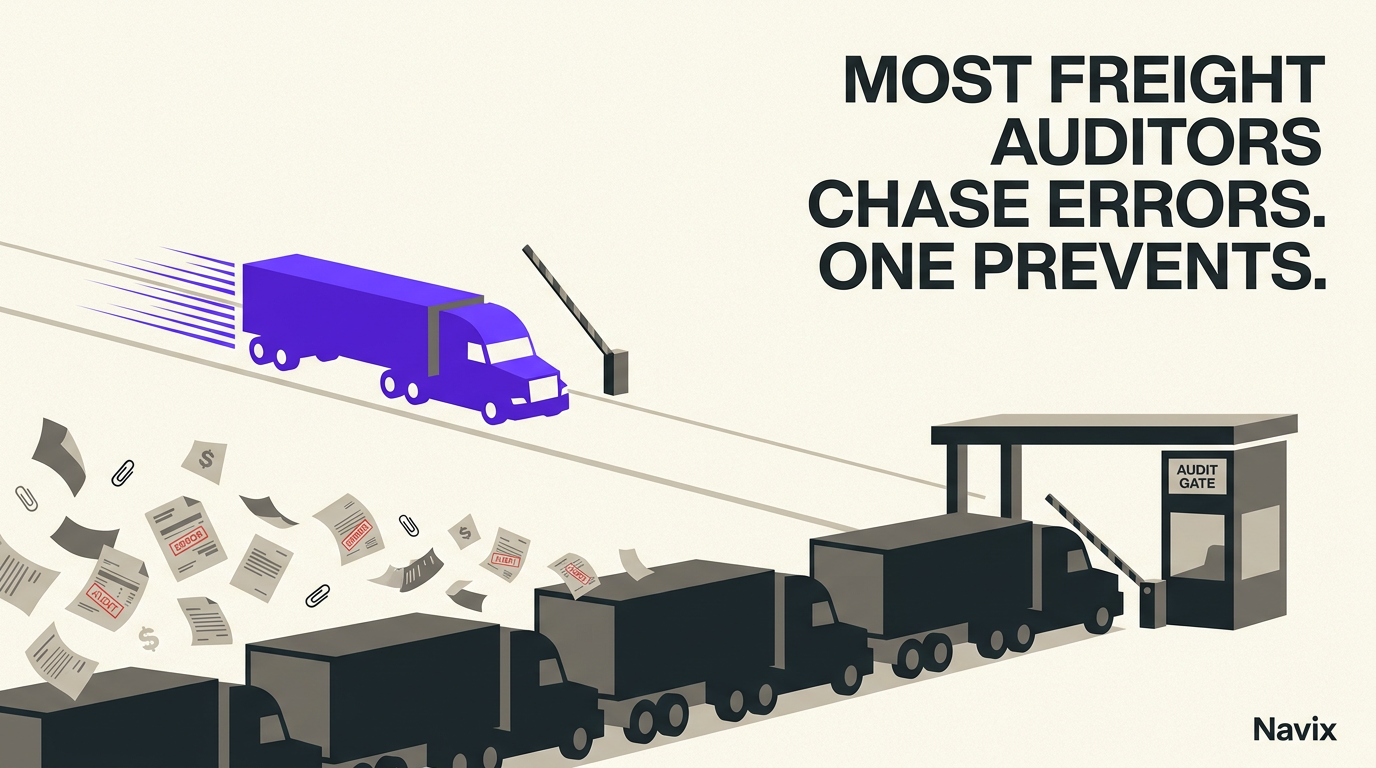
Navix sits in this bucket with a different orientation: the audit
runs pre-bill, and the platform is built for 3PLs and freight brokers
rather than shippers. That distinction is the whole game for a
brokerage. A broker’s margin leaks twice on every bad invoice: once on
the overcharge, and again on the days the customer invoice sits unbilled
waiting for a clean carrier bill and a POD. Auditing before billing
attacks both. KCH Transportation cut DSO from 39 to 28 days with
Navix
Pre-Bill, and Axle Logistics reallocated half its billing team while
growing roughly 300%
(case
study). The Navix freight audit software automates the line-item match between carrier invoice, rate
confirmation, and delivery documents so exceptions surface in hours, not
billing cycles. A fuller feature-by-feature breakdown lives in the
best freight
audit software guide.
What are payment-first
networks?
TriumphPay approaches the problem
from the payments side. It operates a network connecting brokers,
factors, and carriers, with audit capability attached through its
acquisition of HubTran, now TriumphPay Audit (FreightWaves).
For a brokerage whose sharpest pain is paying carriers and factors at
scale, payment rails are the point. For one whose pain is invoice
accuracy and billing speed, audit depth becomes the deciding factor. The
Navix vs. TriumphPay
comparison works through that tradeoff in detail, and the
Navix vs. EPay
Manager comparison covers the adjacent settlement-tool category.
How
should you choose between freight audit companies?
Four questions separate the field faster than any demo:
- Pre-bill or post-audit? Post-audit recovers money
already spent. Pre-bill prevents the error from reaching the customer
invoice, which is what moves DSO and days-to-bill. Brokers and 3PLs that
invoice customers should weight this heavily. - Who was it built for? FAP outsourcers serve
enterprise shippers managing freight spend. A broker or 3PL has a
second, harder problem the shipper tools ignore: getting its own
invoices out clean and fast. - What evidence can the vendor show? Ask for security
attestations and named customer outcomes, not claims. Navix is SOC 2
Type II attested against the Security criteria of the AICPA Trust
Services Criteria
(details). Any
vendor handling rate and payment data should produce equivalent evidence
on request. - What is the integration model? Service bureaus
ingest invoice files on their own schedule. Platforms connect to the TMS
and document sources directly, which determines how fast exceptions
reach the person who can resolve them.
Frequently asked questions
What
is the difference between pre-bill and post-audit freight auditing?
Post-audit reviews invoices after payment and claws back errors,
typically recovering a small share of spend. Pre-bill audit validates
the carrier invoice against the rate agreement and delivery documents
before anything is billed or paid, so the error never enters AR or AP.
For brokers and 3PLs, pre-bill is the only model that also shortens
days-to-bill.
How do freight audit
companies charge?
Pricing models vary by bucket: legacy outsourcers commonly price per
invoice or transaction, some recovery-focused firms take a share of
savings, and software platforms typically sell subscriptions. Get the
model in writing and test it against real monthly volume before
comparing totals, since the same audit scope can price out very
differently across models.
Do
freight brokers need a freight audit company, or is that a shipper
problem?
Brokers arguably need it more. A broker audits inbound carrier
invoices and generates outbound customer invoices, so one bad
accessorial contaminates both sides of the transaction. Axle Logistics
reallocated half its billing team to higher-value work after automating
that double-sided check with Navix.
Is
freight audit software secure enough for rate and payment data?
Evaluate it the way an auditor would: ask for a SOC 2 Type II report
and confirm scope. “SOC 2 attested” or “SOC 2 compliant” is the accurate
phrasing; treat any vendor claiming to be “SOC 2 certified” as a signal
to read the report carefully, because no such certification exists.
The fastest way to test any vendor on this page is to hand it ten
real invoices, including the ugly ones with reweighs and lumper fees,
and time how long clean output takes.
Book a Navix demo and
run that test first.