
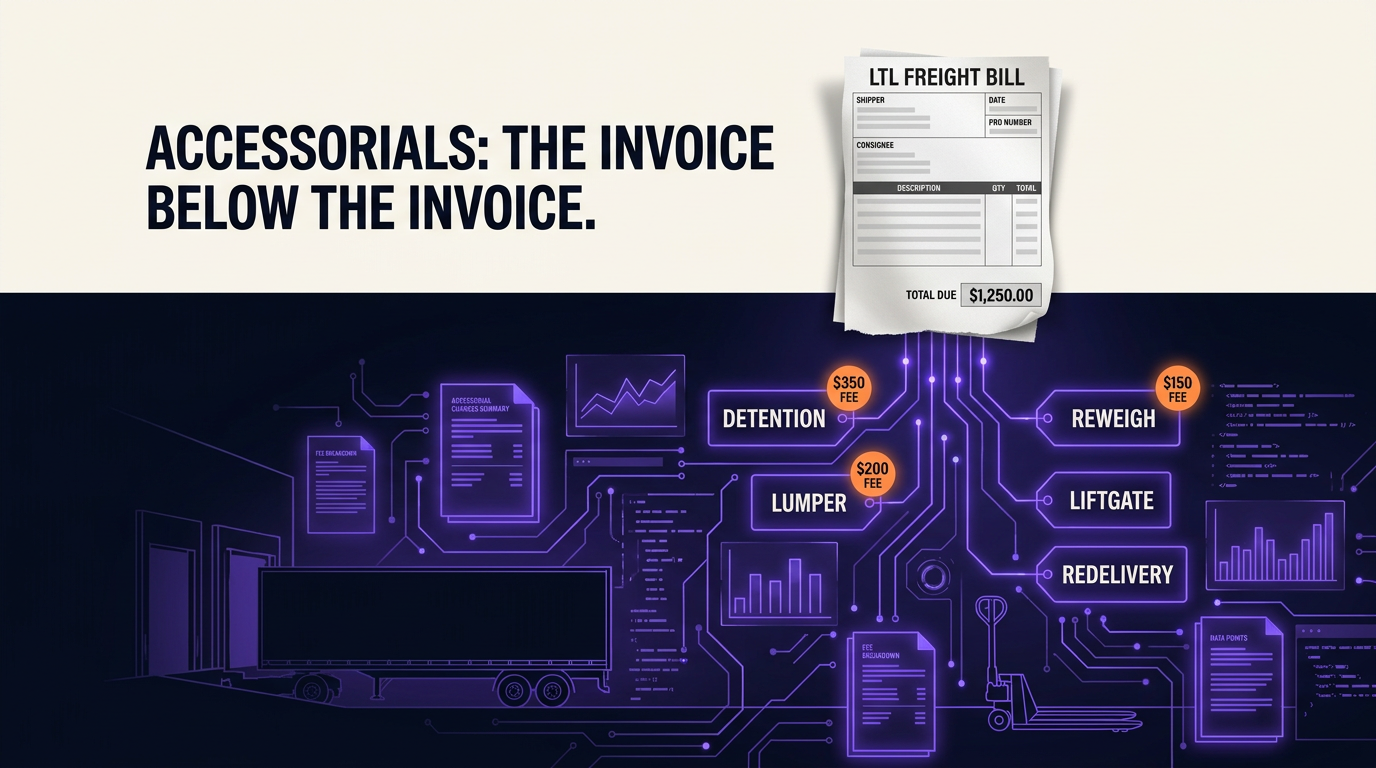
Accessorial charges are fees carriers add to a freight invoice for services beyond standard dock-to-dock pickup and delivery: waiting time, extra labor, special equipment, or handling at hard-to-serve locations. They appear as separate line items on the carrier invoice, on top of the base linehaul rate and fuel surcharge. Because they are event-driven and documentation-dependent, accessorials are where most freight billing errors and disputes live.
What are the most common accessorial charges?
| Accessorial | What it means | Who typically bills it |
|---|---|---|
| Detention | Driver held at a shipper or consignee beyond free time (commonly two hours) while the trailer stays attached | Carrier, to the broker or shipper |
| Demurrage | Equipment (container, railcar, trailer) held at a port, rail yard, or terminal past free days | Ocean carrier, railroad, or terminal; passed through on drayage invoices |
| Lumper fee | Third-party labor unloading the trailer, common at grocery and retail DCs | Lumper service; the driver pays and the carrier rebills with a receipt |
| Liftgate | Hydraulic lift needed at a location without a dock | LTL or final-mile carrier |
| Limited access | Delivery to constrained sites: schools, military bases, construction sites, storage units | LTL carrier |
| Reweigh / reclassification | Carrier reweighs or reclasses the shipment and rebills at the corrected weight or freight class | LTL carrier, with an inspection certificate |
| Redelivery | A second delivery attempt after the first failed (closed receiver, refused freight) | Carrier |
| Layover | Driver held overnight because loading or unloading could not be completed | TL carrier |
| TONU (truck ordered, not used) | Truck dispatched, then the load cancels before pickup | TL carrier or drayage carrier |
| Inside delivery | Freight moved beyond the door or dock, inside the building | LTL or final-mile carrier |
| Residential | Pickup or delivery at a residence or home business, requiring smaller equipment or appointments | LTL or final-mile carrier |
Rates and free-time allowances for each are set in the carrier’s rules tariff or negotiated in the rate agreement. That document, not the invoice, is the source of truth.
How do you verify an accessorial charge is legitimate?
Three questions settle almost every accessorial:
- Did the event actually happen? Detention needs in/out timestamps. A lumper fee needs a receipt. A reweigh needs a certified scale ticket or inspection certificate. A redelivery needs a record of the failed first attempt. No documentation, no charge.
- Is the charge permitted and priced per the agreement? A carrier can bill detention at its tariff rate, but if the rate confirmation caps detention or extends free time, the agreement wins. Reweighs must reference the original BOL weight; reclassifications must cite the NMFC item that applies.
- Is the math right? Detention billed in the wrong increments, liftgate charged at both stops when only one lacked a dock, fuel surcharge applied to an accessorial that should be flat. Small errors, high frequency.
The documentation that answers these questions: the BOL (weight, class, piece count, special instructions), the POD (delivery confirmation and arrival/departure times), the rate confirmation or contract tariff, and event-specific paper such as lumper receipts and reweigh certificates.
How do you dispute an accessorial charge?
Dispute in writing, with the paperwork attached, before paying the line item. A workable sequence:
- Short-pay or hold the line item, not the invoice. Pay the undisputed charges so the carrier relationship and payment terms stay intact.
- Cite the specific document. “Detention denied: POD shows in 09:12, out 10:47, within two hours free time per rate confirmation #4417” closes disputes; “this looks high” does not.
- Set a deadline and track it. Carriers have their own dispute windows, often 30 days or less on LTL reweighs and reclasses. Missing the window converts a winnable dispute into a paid overcharge.
- Log the outcome by carrier and lane. Repeat offenders show up fast, and the pattern is negotiating ammunition at the next rate review.
Volume is the real enemy here. A brokerage moving a few thousand loads a month cannot hand-verify timestamps on every detention claim, so most teams spot-check and eat the rest. This is the specific gap automated line-item audit closes: the Navix freight audit software checks every accessorial on every invoice against the agreement and the documents, and routes only genuine exceptions to a human. Accessorial density is highest in LTL, where reweighs and reclasses are routine, and in drayage, where demurrage and per-diem clocks run at the port. Verifying charges before customer invoicing is also a cash-flow lever: KCH Transportation cut DSO from 39 to 28 days by auditing carrier charges pre-bill with Navix.
FAQ
What is the difference between detention and demurrage?
Detention compensates the carrier for a driver and truck held at a facility beyond free time. Demurrage compensates for equipment (usually a container) occupying a port, terminal, or rail yard past its free days. In drayage both can hit the same load: demurrage at the terminal, then detention at the receiver.
Are accessorial charges negotiable?
Yes. Free-time windows, detention rates, liftgate fees, and TONU amounts can all be set in the rate agreement or contract tariff instead of defaulting to the carrier’s rules tariff. Negotiation only pays off if invoices are actually audited against the negotiated terms afterward.
What documentation do you need to dispute an accessorial?
The rate confirmation or contract (what was agreed), the BOL (what shipped), the POD with timestamps (what happened at delivery), and any event paper: lumper receipts, reweigh certificates, photos of the failed delivery. The side with the better paperwork wins the dispute.
Why do accessorial charges cause so many billing errors?
Because they are manually keyed, event-driven, and priced from tariffs that change. A base rate comes straight off the rate confirmation; an accessorial depends on what happened at a dock, who recorded it, and which tariff applied that day. Every step is a chance for error.
Pull the rules tariff for the top five carriers by spend and check the last month of accessorial lines against it; the leak is usually visible in an afternoon. To run that check on every invoice automatically, book a demo of Navix.