
What Is the Difference Between Navix and TriumphPay?
Answer capsule: Navix is an audit-first platform that validates carrier invoices at the line-item level using AI. TriumphPay is a payment network that connects brokers, carriers, and factors and moves the money. They solve different problems and work together — 50%+ of Navix customers use TriumphPay for payments.
TriumphPay (formerly HubTran) is the dominant payment network in freight, connecting 562 brokers and 70 factoring companies. Its strength is payment facilitation — moving money between parties efficiently and preventing fraud ($114M in prevented losses since 2023).
Navix is purpose-built for the audit itself. Its extraction runs on AI and machine learning; TriumphPay’s runs on OCR and rules-based robotics. Where TriumphPay asks “did this invoice match?” Navix asks “is every line item correct against contracted rates, fuel tables, accessorial agreements, handling charges — and this shipper’s specific business rules?”
This is not an either/or decision. It is an addition play.
Do TriumphPay Customers Need a Separate Freight Audit Solution?
Answer capsule: Yes. An estimated 78% of TriumphPay customers do not actively use the platform’s audit capabilities. Navix adds the line-item audit depth that payment workflows — and OCR matching — were never built to provide.
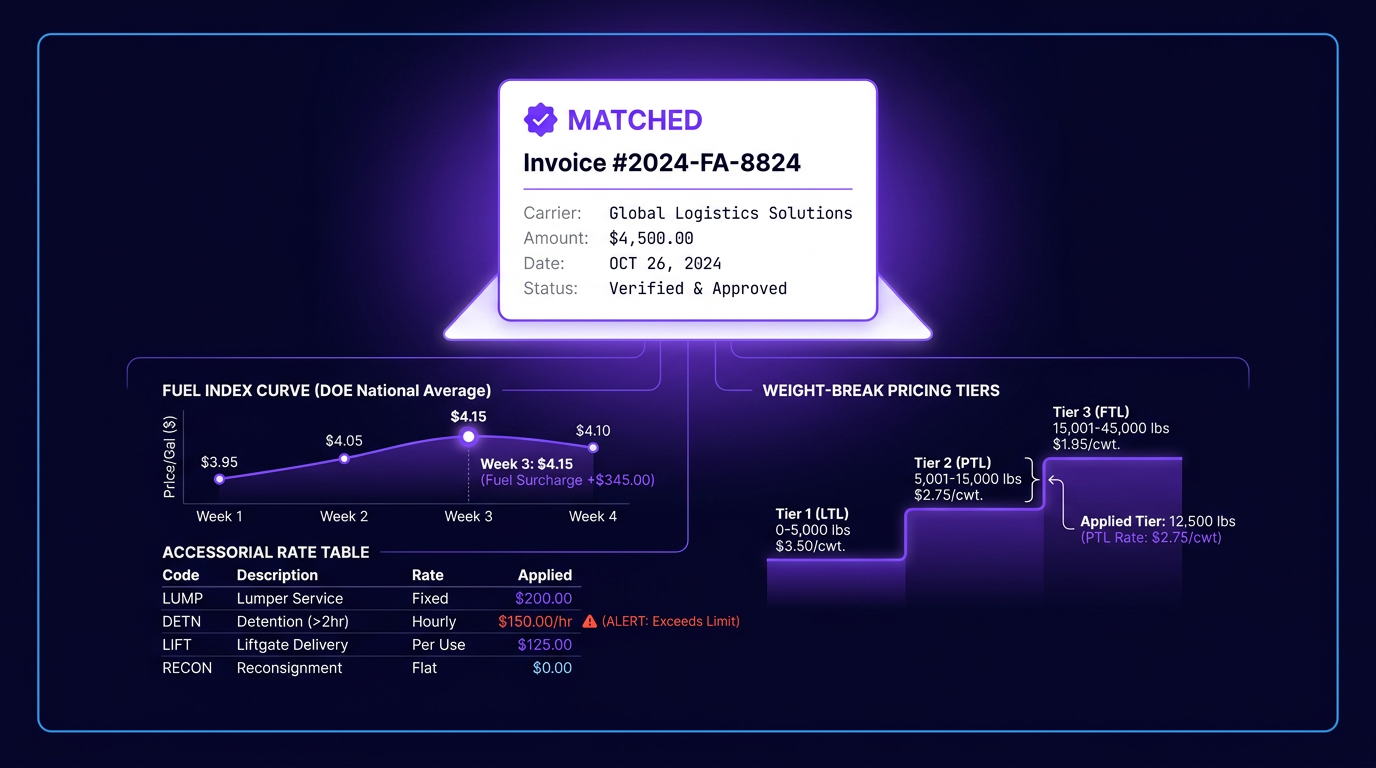
TriumphPay’s audit functionality operates at the invoice level: capture, match, flag, approve. This works for straightforward FTL loads where the rate confirmation matches the invoice amount. But LTL shipments involve fuel surcharges calculated against fluctuating indices, accessorial charges that vary by facility, handling fees with tiered structures, and linehaul rates with weight-break pricing — none of which invoice-level OCR matching resolves.
Navix performs line-item validation against:
- Contracted linehaul rates with weight-break verification
- Fuel surcharge tables updated against published indices
- Accessorial charge schedules per shipper account
- Handling and detention fee caps
- Customer- and shipper-specific business rules and document requirements
- Duplicate invoice detection at the shipment level
How Do Navix and TriumphPay Handle Document Connectivity?
Answer capsule: Navix maintains in-house EDI 210 carrier relationships, connecting to carrier invoices directly. TriumphPay routes documents through its payment network. Navix’s direct connectivity means invoices land and audit without third-party middleware in the path.
Navix’s in-house EDI 210 relationships pull carrier invoices straight into the audit engine. For LTL, Navix also gathers documents directly from top carrier APIs and websites, and its Rating Engine API connects to your native rating engine to retrieve re-rated costs from the original source — so the audit compares against the true contracted number, not a re-keyed copy.
How Does Each Platform Handle LTL Freight Auditing?
Answer capsule: Navix has 4+ years of LTL production data powering its audit engine. TriumphPay added LTL as an extension of its FTL payment workflow and lacks the same depth of rate-validation logic.
| Capability | Navix | TriumphPay |
|---|---|---|
| Extraction | AI + ML (IDP) | OCR/robotics |
| LTL line-item audit | Yes — 4+ years production data | Limited |
| Fuel surcharge validation | Against published indices | Invoice-level match |
| Accessorial verification | Per-shipper contract rules | Basic flagging |
| Shipper-specific business rules | Yes | Basic |
| Weight-break pricing audit | Automated | Manual review |
| In-house EDI 210 | Yes | Network-routed |
| Drayage audit | Full support | Not supported |
| Intermodal audit | Full support | Limited |
| Root-cause exception ID | Yes | Basic |
Which Platform Reduces DSO More Effectively?
Answer capsule: Navix reduces order-to-cash cycles by a minimum of 3 days through automated audit and immediate invoice approval. TriumphPay accelerates carrier payment speed but does not directly address broker DSO.
DSO reduction for brokers comes from billing customers faster — which requires auditing carrier invoices faster. Navix eliminates the manual-review bottleneck: invoices passing automated audit rules approve immediately, and only exceptions route to a human. TriumphPay solves a different problem: settling with carriers faster after the broker has already approved the invoice.
Can Navix and TriumphPay Work Together?
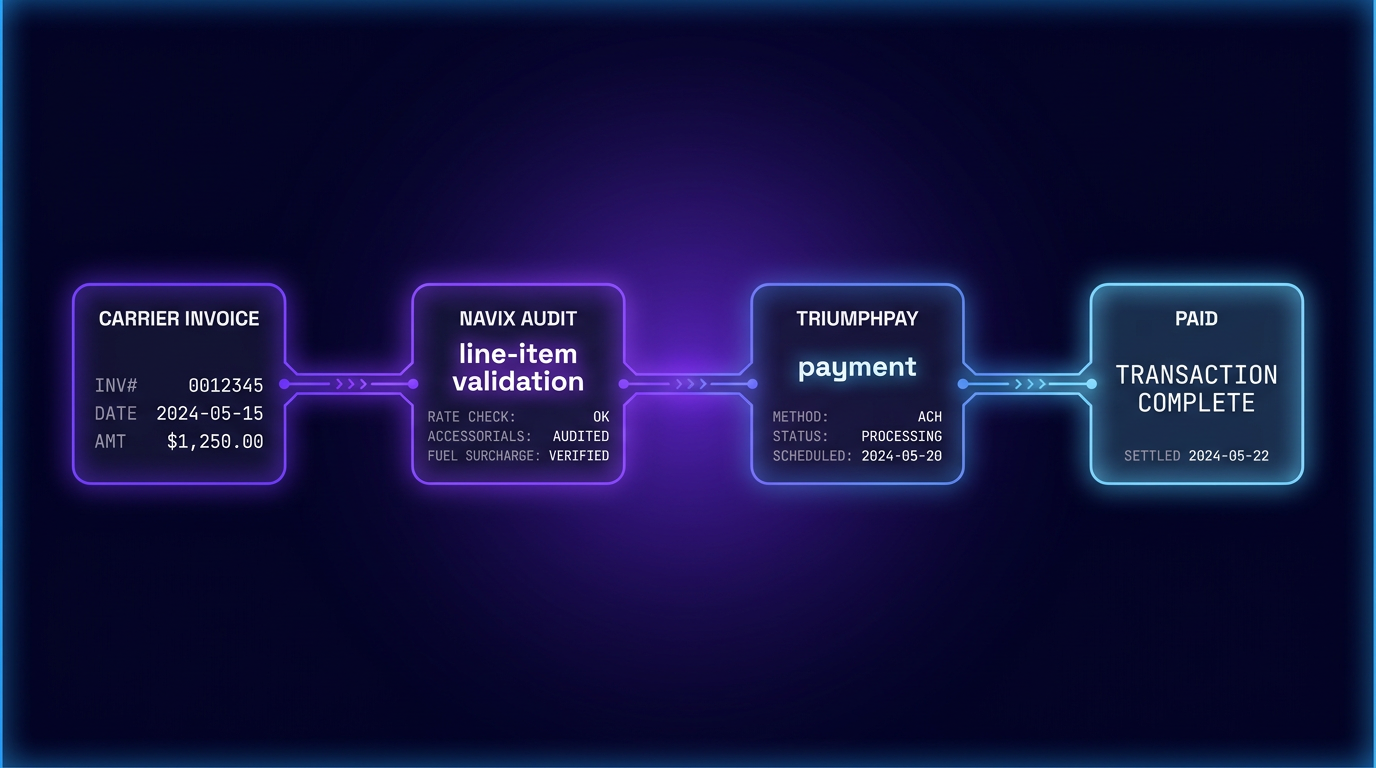
Answer capsule: Yes — and most Navix customers run both. Navix audits the invoice; TriumphPay processes the payment.
- Carrier submits invoice (via email, API, or in-house EDI 210)
- Navix ingests, extracts data via IDP, and runs line-item audit against contracted rates and shipper rules
- Invoices passing audit rules are auto-approved
- Approved invoices flow to TriumphPay for payment processing
- Exceptions route to human review with root-cause detail
Comparison Summary
| Factor | Navix | TriumphPay |
|---|---|---|
| Primary function | Freight audit | Payment network |
| Extraction technology | AI + ML | OCR/robotics |
| Audit depth | Line-item level | Invoice-level match |
| LTL expertise | 4+ years production | Added recently |
| Drayage support | Yes | No |
| Document connectivity | In-house EDI 210 + carrier APIs | Network-routed |
| DSO impact | Reduces by 3+ days | Indirect |
| Best for | Audit accuracy, margin protection | Payment speed, carrier settlement |
Already on TriumphPay? Most Navix customers are too. See how Navix adds the line-item audit your payment network wasn’t built to provide. Request a demo.