
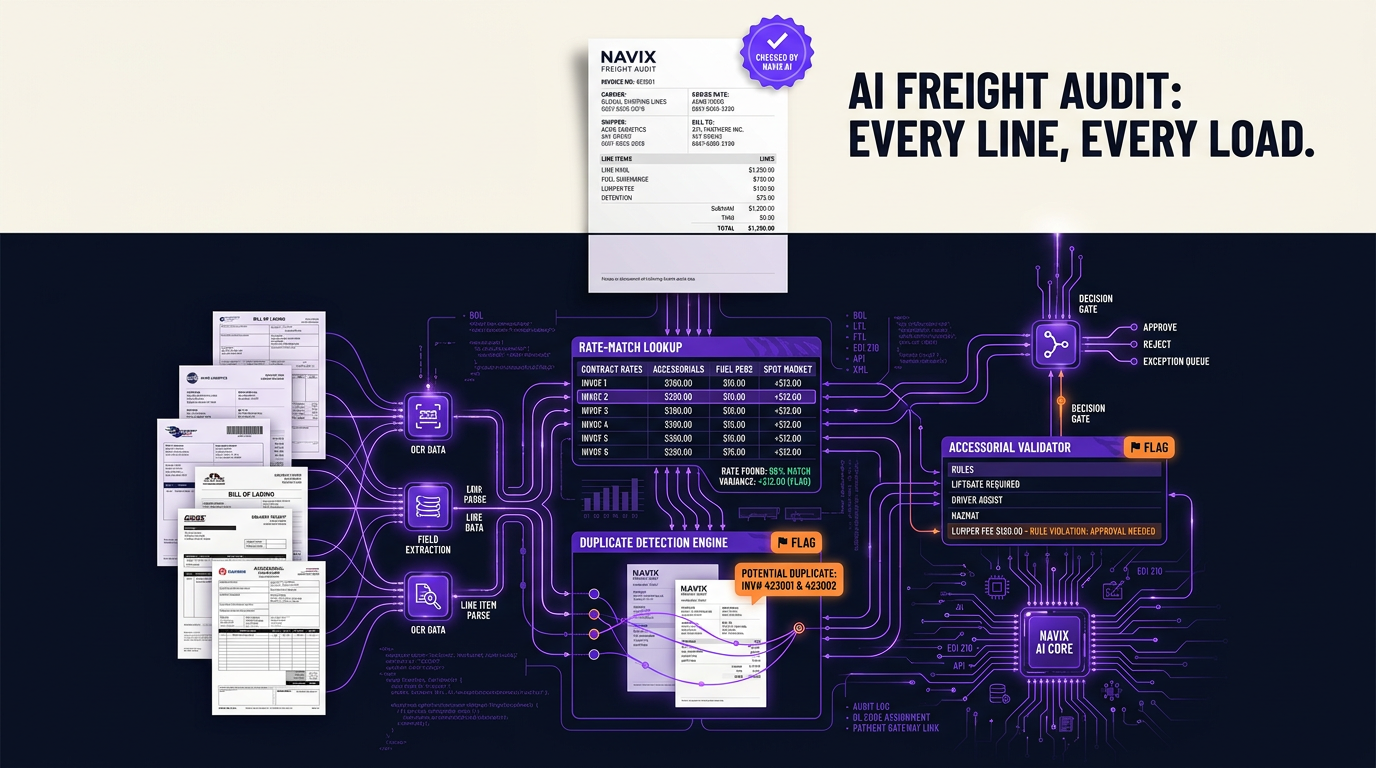
An AI freight audit uses machine learning to read carrier invoices in any format, match every line item against contracted rates, validate accessorial charges, and surface exceptions for human review — on every invoice, not a sample. It replaces the manual spot-check, where an auditor eyeballs a fraction of invoices and hopes the errors land in that fraction. What it does not replace is judgment: dispute decisions, carrier relationships, and contract negotiation stay with people.
What does an AI freight audit actually do?
Five jobs, all of them tedious and all of them better done by software:
- Line-item extraction from any invoice format. Carrier invoices arrive as EDI, PDFs, scanned images, and portal downloads, each with its own layout. AI extraction reads them all and normalizes line items — linehaul, fuel, detention, liftgate, reweigh adjustments — into structured data without format-specific templates.
- Rate-versus-contract matching. Every extracted charge is checked against the contracted rate, the rate confirmation, or the quote for that lane. Mismatches get flagged with the delta, not buried in a line 14 of a PDF nobody reads.
- Accessorial validation. Detention billed without supporting timestamps, a liftgate fee on a dock-delivery, a reweigh with no updated weight ticket — accessorials are where carrier invoices drift, and validation logic catches drift the human eye misses at volume.
- Duplicate detection. The same load billed twice under two pro numbers, or the same accessorial appearing on both the original and corrected invoice. Duplicates are trivial for software to catch and genuinely hard for a person processing hundreds of invoices a day.
- Exception surfacing. Clean invoices pass straight through. Only the invoices with a real discrepancy reach a person, with the discrepancy already identified and documented.
Why does every-invoice coverage matter?
Manual audit teams sample because they have to — nobody can hand-check every invoice on every load. Sampling means most invoices are never audited at all, and the errors on unsampled invoices simply become cost. AI audit inverts the economics: checking invoice ten thousand costs the same as checking invoice one, so coverage goes to 100% and the question shifts from “which invoices should we check?” to “which exceptions deserve attention first?” That shift is the entire point. The Navix freight audit software runs this model as a pre-bill audit, so errors are caught before the customer invoice goes out rather than clawed back afterward.
What does “agentic” mean in freight audit?
“Agentic” means the software carries a multi-step task to completion instead of stopping at a flag. A conventional rules engine notices a missing POD and creates a task for a person. An agentic audit notices the missing POD, requests it from the carrier, receives and attaches it, re-validates the invoice, and only escalates if the carrier does not respond. The person enters at the decision point, not the fetch-and-file steps. In practice, agentic freight audit covers document chasing, invoice re-checks after corrections, and routing exceptions to the right owner — the workflow around the audit, not just the audit itself.
What stays human?
- Dispute judgment calls. The software proves the detention charge lacks timestamps. Whether to fight it, split it, or eat it to keep a carrier on a tight lane is a business decision.
- Carrier relationships. A carrier that consistently over-bills needs a conversation, not an algorithm. The audit supplies the evidence; a person supplies the conversation.
- Contract negotiation. Audit data reveals which accessorial terms generate constant friction, which is excellent input for the next rate negotiation. The negotiation itself remains human work.
What are the honest limits?
AI audit is only as good as the reference data it matches against. If contracted rates live in a spreadsheet nobody maintains, the audit inherits that mess — flagging false errors and missing real ones. Extraction confidence drops on badly scanned documents, and low-confidence reads should route to review rather than pass silently. Novel accessorial situations with no contractual reference still require interpretation. And no audit model recovers money by itself; it produces defensible evidence, and people still act on it. Vendors who skip this caveat section are selling something.
One limit worth checking directly: where audit data lives and who can touch it. Carrier invoices carry rate data both sides consider confidential. Navix is SOC 2 Type II attested against the Security criteria of the AICPA Trust Services Criteria — details on the SOC 2 Type II page and the security overview.
FAQ
Is AI freight audit accurate enough to replace manual auditing?
For extraction, matching, and duplicate detection, software outperforms manual review at any real volume, because it never fatigues and checks every invoice. Accuracy depends on the quality of the contract and rate data behind it, which is why implementation starts with cleaning that reference data.
What is the difference between AI freight audit and traditional freight audit?
Traditional audit is rules plus people plus sampling: a subset of invoices, checked after the fact, often after payment. AI audit is every invoice, checked pre-bill, with people handling only surfaced exceptions. Comparison criteria for evaluating vendors are laid out in the best freight audit software guide.
Does agentic freight audit mean invoices get paid without human approval?
No. Agentic refers to completing workflow steps — chasing documents, re-validating corrected invoices, routing exceptions. Payment approval thresholds and dispute decisions remain configurable human checkpoints.
Can AI audit handle LTL invoices?
LTL is where AI audit earns its keep, because reweighs, reclassifications, and dense accessorial schedules make LTL invoices the most error-prone in freight. See LTL freight audit software for the specifics.
The test to run on any vendor
Ask one question: does the audit run before or after the customer invoice goes out? Post-audit finds errors after they have already reached the customer or been paid. Pre-bill audit means the error never leaves the building. To see every-invoice, pre-bill audit running on live freight, book a demo with Navix.