
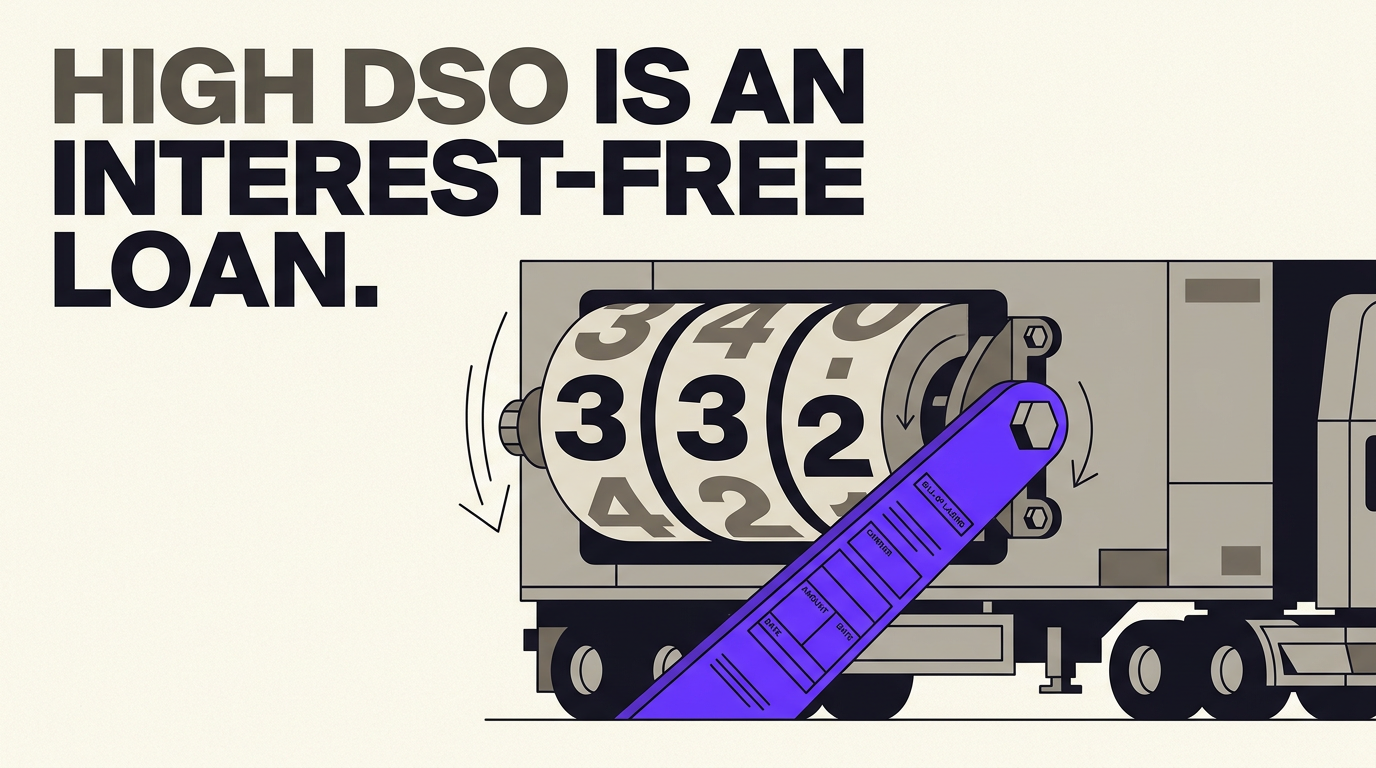
Reducing DSO in freight means compressing the time between a delivered load and a clean, documented invoice sitting in the customer’s AP queue — then defending that invoice against disputes. Days sales outstanding (DSO) measures how long revenue sits in receivables after delivery, and in freight, most of those days are burned before the invoice is ever sent. The nine levers below attack days-to-bill first, dispute exposure second, and collections mechanics last, because that is the order of impact.
Why does DSO run high in freight?
Freight billing is document-driven. An invoice cannot go out until the POD is in hand, the carrier invoice is reconciled against the quoted rate, and accessorials — detention, liftgate, reweighs — are validated. Every one of those steps is a place where a delivered load sits unbilled. The customer’s payment clock starts when the invoice arrives; the broker’s cash clock started at delivery. The gap between those two clocks is where most freight DSO lives, which means the fastest reductions come from billing speed, not collections pressure.
The 9 levers that reduce freight DSO
1. Bill the same day the POD lands
Generate and send the invoice the day delivery documents arrive, not in a weekly batch. Every day between POD receipt and invoice transmission is pure, self-inflicted DSO. A weekly billing cycle parks every load in a queue where it earns nothing; same-day billing removes that queue entirely.
2. Audit before you bill, not after
A pre-bill audit reconciles the carrier invoice against the quote, checks accessorials against contract terms, and confirms documentation before the customer invoice goes out. An invoice that is right the first time never boomerangs back as a short-pay or a dispute, and disputes are where DSO goes to die. KCH Transportation cut DSO from 39 to 28 days after adopting Navix Pre-Bill — the full numbers are in the freight brokerage DSO case study.
3. Automate document collection
Chasing carriers for PODs and BOLs is usually the longest pole in days-to-bill. Automated document collection requests, receives, and attaches paperwork to the load file without a billing clerk sending emails. When the POD attaches itself, the invoice can leave the same day the freight does.
4. Prevent disputes instead of resolving them
Dispute resolution is measured in weeks; dispute prevention is measured in data quality. Validating accessorial charges, reweigh adjustments, and rate applications before billing means the customer’s AP team finds nothing to push back on. Every dispute avoided is thirty-plus days of aging that never happens.
5. Keep payment terms hygienic
Terms drift. The rate confirmation says net 30, the master agreement says net 45, the invoice footer says due on receipt. AP departments resolve ambiguity in their own favor, always toward the longer date. Align terms across every document, state them on every invoice, and enforce them on every account.
6. Deliver invoices into AP portals
An emailed PDF can sit unopened in an inbox for days before the customer’s clock even starts. E-invoicing directly into the customer’s AP portal timestamps receipt, eliminates the “never got it” excuse, and starts the payment countdown the moment the invoice is ready.
7. Put SLAs on exception triage
Missing PODs, rate mismatches, and reweigh discrepancies will always exist. What kills DSO is exceptions without an owner or a clock. Set internal SLAs — every exception gets an owner within hours and a resolution target in days — and aging exceptions surface instead of hiding.
8. Know what factoring actually buys
Factoring converts receivables to immediate cash, and for a cash-strapped brokerage that can be the right call. But it sells margin to paper over a billing problem, and the underlying days-to-bill lag remains. Treat factoring as a bridge, and fix the billing engine so the bridge gets shorter.
9. Track DSO and days-to-bill weekly
DSO is a lagging indicator; days-to-bill is the leading one. Reviewing both weekly, by customer and by lane, shows exactly where cash is stuck — a slow-paying account, a document-heavy lane, a billing backlog. The Navix freight audit software was built around this sequence: audit every carrier invoice pre-bill, attach documents automatically, and push clean invoices out the day the load delivers. Teams evaluating options can compare approaches in the guide to the best freight audit software.
FAQ
What is a good DSO for a freight brokerage?
Judge DSO against stated terms rather than an industry average. If terms are net 30 and DSO runs well past it, the excess is coming from billing lag, disputes, or unenforced terms — all fixable. KCH Transportation’s move from 39 to 28 days shows what closing the billing gap alone can recover.
Does factoring reduce DSO?
It removes receivables from the balance sheet, so measured DSO drops, but the cost is a permanent haircut on margin. Billing-speed improvements produce the same cash acceleration without giving up a percentage of every invoice, which is why factoring works better as a temporary bridge than a strategy.
What is the difference between DSO and days-to-bill?
Days-to-bill measures delivery to invoice sent; DSO measures the full stretch from delivery to cash received. Days-to-bill is the portion entirely within the broker’s control, which makes it the first number to fix and the best early warning when DSO starts creeping.
How does a pre-bill audit reduce DSO?
It ensures the invoice is accurate before the customer sees it — correct rate, validated accessorials, POD attached. Clean invoices get paid on terms; flawed invoices enter dispute cycles that add weeks. Prevention beats collection every time.
Run the split this week
Take last month’s delivered loads and measure two numbers: delivery to invoice sent, and invoice sent to cash. If the first number is the bigger problem, the fix is inside your own billing operation, and it is the cheaper fix by far. To see how a pre-bill audit compresses that first number, book a demo with Navix.