
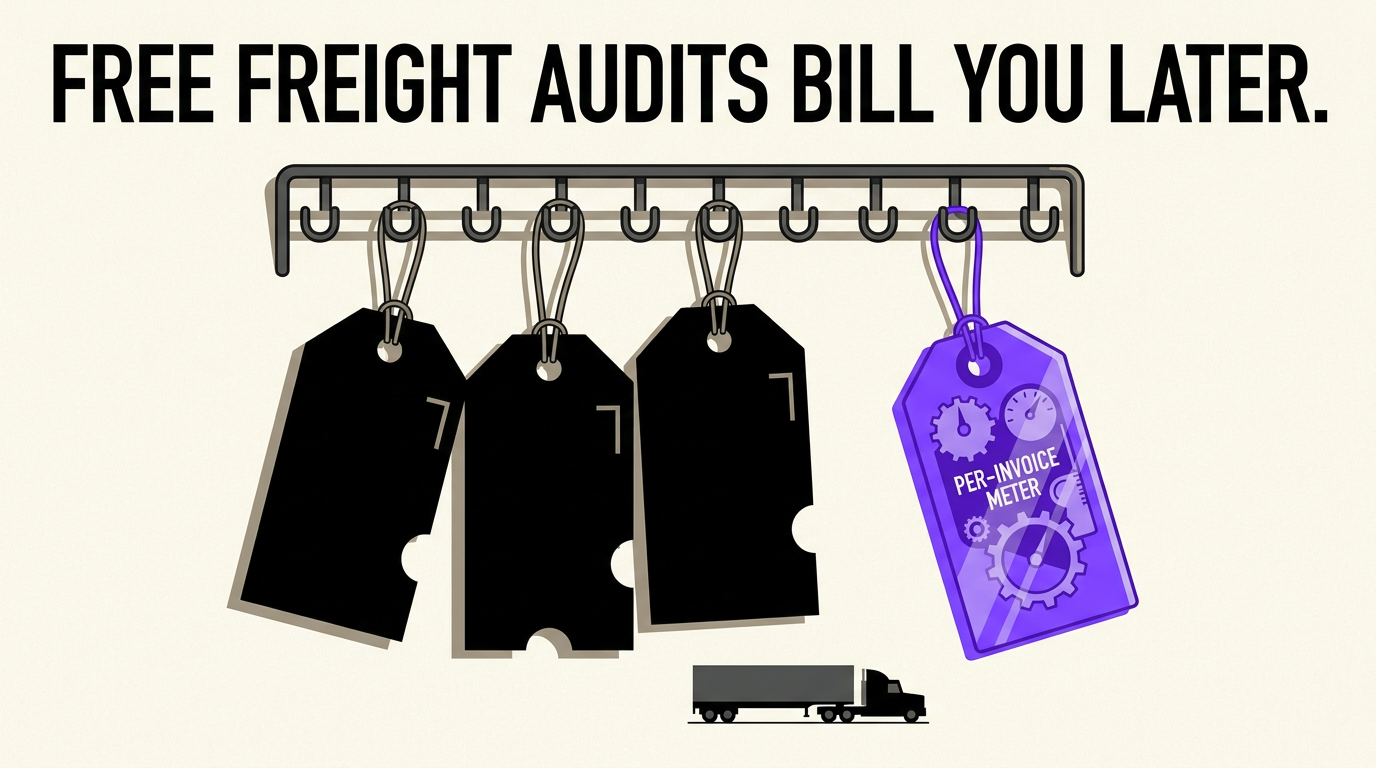
Freight audit pricing follows four models: per-invoice transaction fees, a percentage of audited freight spend, gainshare (the vendor keeps a share of recovered savings), and flat platform subscription. Vendors rarely publish numbers, because the real answer depends on invoice volume, mode mix, and how much of the work the software does versus offshore labor. The model a vendor chooses tells you more than the quote does — it tells you what they are incentivized to do with your errors.
What are the four freight audit pricing models?
Per-invoice transaction fees
A fixed fee for every invoice processed, sometimes tiered by volume or mode — LTL invoices with reweighs and dense accessorial schedules typically price above clean truckload invoices. The model is predictable and scales linearly with volume, which makes budgeting easy. Watch for what counts as a billable “invoice”: corrected invoices, rebills, and duplicates can each ring the register if the contract is loose.
Percentage of freight spend
The vendor takes a percentage of the total freight spend flowing through the audit. Simple to administer, but it decouples price from work: freight rates rising raises the audit bill even though the audit effort is unchanged. It also mildly rewards the vendor for higher spend, which is the opposite of what the audit is for.
Gainshare: a percentage of recovered savings
The vendor keeps a share of the errors they catch — often pitched as “you pay nothing unless we find something.” Consider the incentive underneath. A gainshare vendor’s revenue depends on errors continuing to exist. Fixing the root cause — correcting a bad rate table, confronting a carrier that systematically over-bills, preventing errors before invoices go out — shrinks the vendor’s own paycheck. The model rewards catching the same error every month forever, and it rewards post-audit (finding errors after payment) over pre-bill prevention. Gainshare can make sense as a short recovery project on historical invoices; as a permanent operating model, the incentives point the wrong way.
Platform subscription
A flat recurring fee for the audit platform, sometimes with volume bands. The vendor’s revenue does not move with error counts, so nothing rewards leaving errors in place — the incentive is to automate the audit well enough that the customer keeps renewing. This is the model behind the Navix freight audit software, where the audit runs pre-bill on every invoice rather than recovering errors after they have been paid.
What drives total cost beyond the sticker price?
Three factors routinely outweigh the fee itself:
- Implementation. Rate tables, contracts, and accessorial schedules have to be loaded and validated before the audit can match against them. Ask what the vendor does versus what your team does, and how long the first clean audit takes.
- Integrations. The audit layer must connect to the TMS on one side and the accounting system on the other. Per-integration fees, custom connector work, and “professional services” line items live here.
- Headcount displaced — or not. The largest number in the equation is usually labor. An audit that automates document collection and exception triage changes what the billing team spends its days on; an audit that just produces exception reports for your staff to work does not. Axle Logistics reallocated half of its billing team after automating its audit flow and grew roughly 300% — the Axle Logistics case study shows what the labor side of the equation is worth.
Why isn’t a “free” freight audit actually free?
Free audit offers are almost always post-audit gainshare: the vendor audits paid invoices, keeps a cut of recoveries, and charges no fee. The costs are just indirect. Errors are recovered after payment instead of prevented, so working capital funds the mistakes in the meantime. Recovery claims strain carrier relationships in a way pre-bill correction does not. And the structural incentive problem applies in full: the vendor eats only what the error stream feeds them, so the error stream must flow. A pre-bill audit that prevents the overcharge from ever being paid delivers the same dollars without the float loss or the clawback friction.
What should you ask any freight audit vendor before signing?
- Does the audit run pre-bill or post-payment? Prevention and recovery are different products.
- What exactly counts as a billable transaction, and what happens with rebills and corrections?
- What share of invoices is audited — every invoice, or a sample?
- If pricing is gainshare: what happens to your revenue when errors decline? Listen carefully.
- What is included in implementation, and what is billed as services?
- How is invoice and rate data secured, and can you show an independent attestation? Navix, for reference, is SOC 2 Type II attested against the Security criteria of the AICPA Trust Services Criteria — see the SOC 2 Type II overview.
Head-to-head comparisons help sharpen these questions — the Navix vs. TriumphPay and Navix vs. ePay Manager pages walk through where the models differ, and the best freight audit software guide covers the wider field.
FAQ
Which freight audit pricing model is cheapest?
There is no universally cheapest model — a per-invoice fee beats percentage-of-spend at high average freight rates, and subscription beats transaction pricing at high volume. The better question is which model’s incentives you want operating on your invoices for the next three years.
Is gainshare freight audit ever a good deal?
As a one-time recovery sweep on historical paid invoices, it can be, since there is no ongoing relationship to distort. As a permanent model, the vendor profits from errors persisting, which is a poor foundation for a service whose job is eliminating them.
Does freight audit pay for itself?
The recoverable categories are concrete: rate mismatches, invalid accessorials, duplicate billings, and the DSO reduction from cleaner, faster invoicing. Whether the total covers the fee depends on error rates and volume, which is why any serious vendor will run your historical invoices through the audit before quoting.
What is the difference between freight audit cost for pre-bill vs. post-audit?
Post-audit prices against recovered dollars after payment; pre-bill prices against the invoice flow and prevents the payment from happening at all. Pre-bill carries the added return of faster billing and fewer disputes, which shows up in DSO rather than the audit invoice.
Price the incentive, not just the fee
Before comparing quotes, write down what each vendor earns when your error rate drops to near zero. Any model that answers “less” is renting your problem, not solving it. To see per-invoice, pre-bill audit economics on your own freight, book a demo with Navix.