
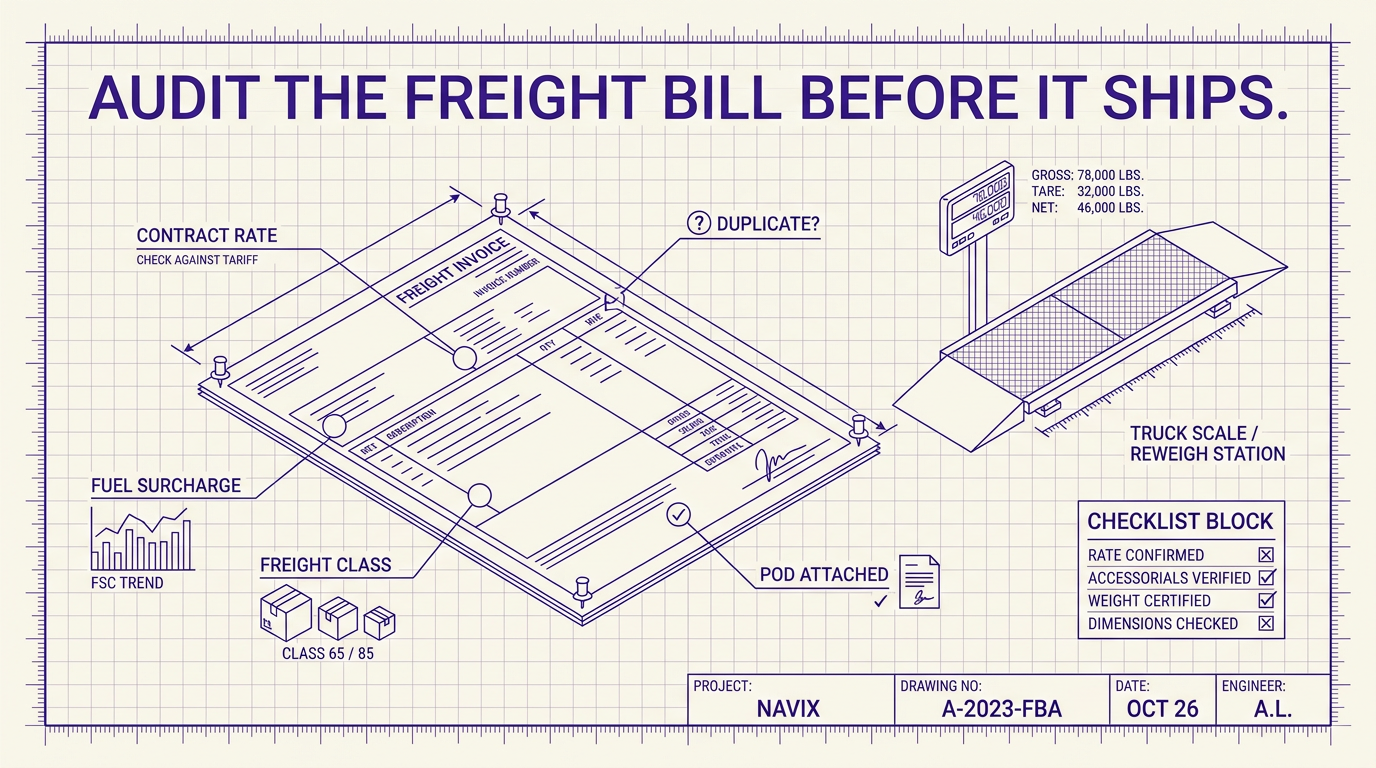
Auditing a freight invoice means verifying every line item on the carrier’s bill against the contracted rate, the shipment documentation, and basic arithmetic before the invoice is approved for payment. The core comparison set is four documents: the carrier invoice, the rate confirmation or contract, the BOL, and the POD. Any line the documents cannot support is an exception, and exceptions get disputed, not paid.
The checklist below is the full line-item pass, in the order most audit teams work it.
The 8-point freight invoice audit checklist
- Rate vs. contracted rate. Match the invoiced linehaul to the rate confirmation (TL) or the contract tariff and applicable discount (LTL) for that lane, that equipment, that date. Common failure: the carrier bills from its standard tariff instead of the negotiated rate, or applies the right rate to the wrong lane after a multi-stop change.
- Accessorials vs. the agreement. Every accessorial line needs two proofs: the agreement permits the charge at that price, and documentation shows the event happened (timestamps for detention, a receipt for a lumper fee, a record of the failed attempt for redelivery). Common failure: legitimate event, wrong price, because the invoice pulls the tariff rate while the rate confirmation negotiated a lower one.
- Fuel surcharge calculation. Recompute the surcharge from the agreed index, the schedule in the contract, and the correct week. Common failure: the wrong week’s index, or a percentage surcharge applied to accessorials when the agreement applies it to linehaul only.
- Reweigh and reclassification verification. If the carrier rebilled at a new weight or freight class, demand the certified scale ticket or inspection certificate and compare against the BOL as tendered. Check the NMFC item cited and whether density-based rules were applied correctly. Common failure: a reclass applied with no inspection certificate attached, which is an automatic dispute.
- Duplicate invoice detection. Search for the same PRO number, load number, or BOL number already invoiced, including under a slightly different invoice number or amount. Common failure: a corrected rebill paid alongside the original because the two arrived weeks apart and nobody matched them.
- Math errors. Sum the line items and compare to the invoice total; recheck unit math (miles times rate per mile, hundredweight times rate). Common failure: a corrected line edited on the carrier side without the total being recalculated.
- POD match. Confirm a signed POD exists, the consignee and date align with the load, and any notations (shortage, damage, late arrival) are reflected before billing the customer. Common failure: paying and billing a load whose POD later surfaces with an OS&D notation the customer disputes.
- Payment terms. Verify the invoice is being scheduled per the agreed terms and that any quick-pay discount the carrier elected is actually applied. Common failure: quick-pay taken by the carrier at the discounted amount while the full amount gets scheduled, or terms measured from invoice date when the agreement says delivery date.
What documents do you need before starting?
Four minimum: the carrier invoice, the rate confirmation or contract tariff, the BOL, and the POD. For specific line items, add the event paper: lumper receipts, reweigh certificates, detention timestamps, and the accessorial schedule from the rules tariff. An audit without the rate confirmation is a proofread; only the agreement makes it an audit.
Can you audit every invoice manually?
At low volume, yes. Past a few hundred invoices a month, the eight checks above collide with headcount math, and teams quietly downgrade to sampling: full audit above a dollar threshold, rubber stamp below it. The result is predictable. Errors concentrate in exactly the lines nobody reads: small accessorials, fuel table drift, duplicate rebills under the threshold.
AI-driven line-item audit removes the sampling compromise. Software extracts every line, runs all eight checks against the contract and the documents, and surfaces only true exceptions for human judgment. That is the model behind the Navix freight audit software: every invoice audited, including LTL with its reweigh and reclass churn and drayage with its per-diem and demurrage clocks. Because Navix runs the audit pre-bill, verification stops delaying customer invoicing: KCH Transportation cut DSO from 39 to 28 days on this model, and Axle Logistics reallocated half its billing team while growing roughly 300%. For a comparison of audit-first platforms against payment processors with audit features, see the freight audit software guide.
FAQ
What percentage of freight invoices contain errors?
Published figures vary widely by mode and carrier mix, so a self-measured baseline beats any industry number: audit one month of paid invoices against the eight checks above and calculate an internal error rate. LTL, with reweighs, reclassifications, and dense accessorial tariffs, reliably produces more exceptions than contracted TL.
How long does a manual freight invoice audit take?
A clean TL invoice with no accessorials takes a few minutes to match against the rate confirmation and POD. An LTL invoice with a reclass, or any invoice requiring document chasing, can take far longer, and chase time is why manual programs drift into sampling.
What is the difference between a freight bill audit and a freight audit?
Nothing meaningful. “Freight bill audit” and “freight invoice audit” both describe verifying carrier charges before payment. The distinction that matters is timing: post-audit recovers overcharges after payment, while pre-bill audit verifies charges before the customer invoice is generated, protecting both margin and days-to-bill.
Should the audit happen before or after the carrier is paid?
Before, and ideally before the customer is billed. Recovering an overcharge after payment requires the carrier’s cooperation and finance’s patience. Rejecting the same charge pre-payment requires an email. Pre-bill audit adds the second benefit: the customer invoice goes out fast and correct.
Run the eight checks against last month’s ten largest carrier invoices; anything that fails is already leaking margin at scale. To put the full checklist on every invoice automatically, book a demo of Navix.