
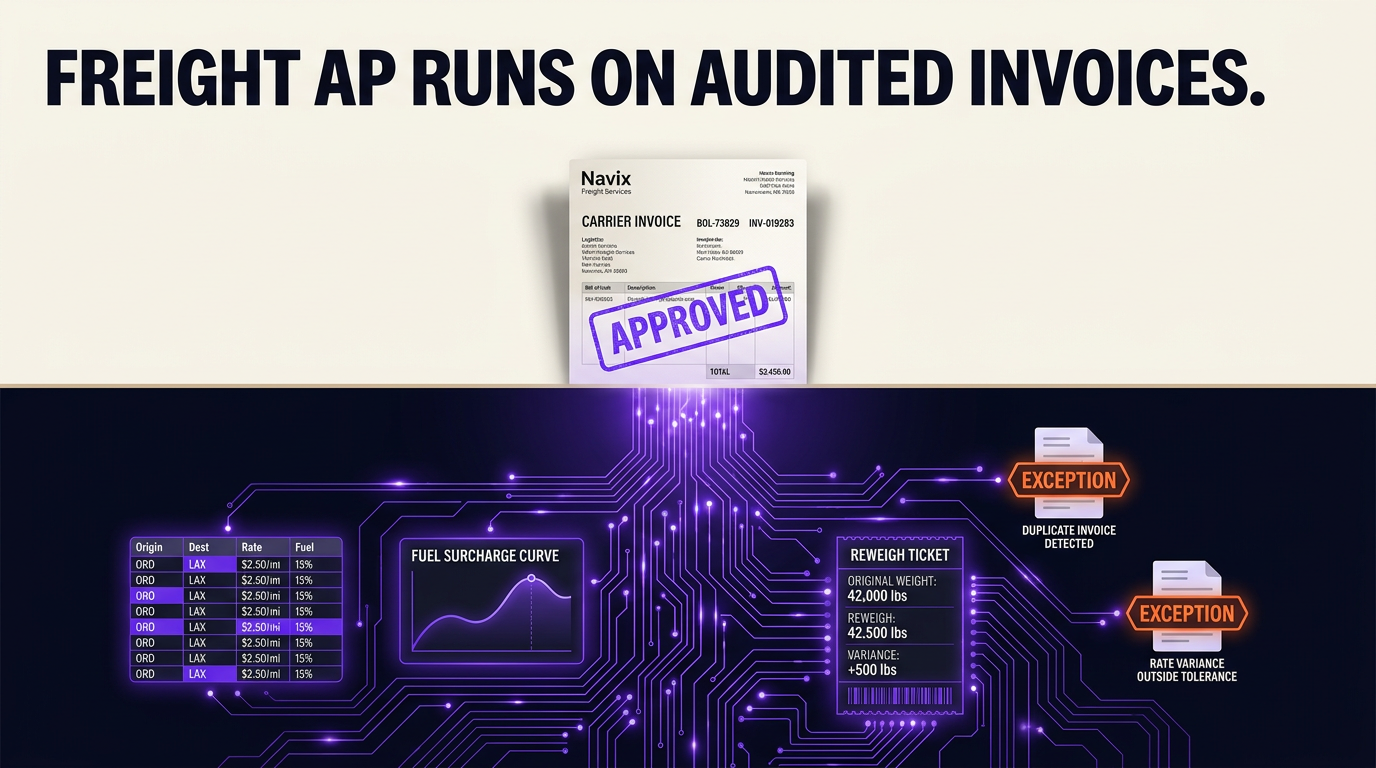
AP
Automation for Logistics: Freight Forwarders, Brokers, and Shippers
AP automation for logistics is software that ingests carrier
invoices, validates every line item against rates and shipment
documents, routes exceptions to the right person, and releases approved
invoices for payment. Generic AP tools built for office supplies and
SaaS subscriptions handle the first step and skip the second, which is
exactly where freight money leaks. The validation step is the product;
everything else is plumbing.
Why
do generic AP automation tools fail on freight invoices?
A standard AP platform does three things well: it OCRs a PDF, matches
the invoice to a purchase order, and routes it for approval. That model
assumes the invoice amount is either right or obviously wrong.
Carrier invoices break that assumption on almost every line:
- Accessorials appear after the rate was quoted.
Detention, liftgate, lumper fees, redelivery, and inside delivery
charges land on the invoice with no PO line to match against. The only
way to validate them is against the rate agreement and what actually
happened on the load. - Reweighs and reclassifications change the billable
amount after pickup. An LTL invoice priced at class 70 can come back
reweighed and rebilled at class 125, and an OCR tool will happily read
the new number and route it for approval. Catching it requires the
original BOL, the carrier’s inspection certificate, and the contracted
rules, which is the core job of
LTL freight
audit software. - Rate-table lookups are the actual audit. Freight
pricing lives in lane-based rate tables, contract tariffs, and spot rate
confirmations. Validating an invoice means finding the governing rate
for that origin, destination, weight, and class, then recomputing the
charge. No generic AP tool carries that logic. - Fuel surcharges float with published indexes and
reset weekly. A surcharge that was correct when quoted can be wrong by
invoice time, in either direction. - Duplicate and split billing hides in volume. The
same load can arrive as a carrier invoice, a revised invoice after a
reweigh, and a balance-due invoice weeks later.
Drayage adds its own layer: per-diem, chassis splits, and port fees
that arrive long after the container moved, which is why
drayage audit
software exists as its own category. An OCR-and-route tool processes
all of these invoices efficiently. It just approves the wrong amounts
efficiently.
What does a
freight-specific AP flow look like?
The flow that works has five stages, and the order matters:
- Intake. Invoices arrive by EDI, carrier portal, and
email, in every format carriers produce. Intake normalizes them into
structured line items without requiring carriers to change how they
bill. - Line-item audit. Each charge is matched against the
rate confirmation, contract tariff, BOL, and POD. This is where AI earns
its keep: reading unstructured invoice formats, finding the governing
rate, and recomputing charges at line level rather than invoice
level. - Exception resolution. Most invoices should pass
untouched. The ones that fail get routed with the evidence attached: the
invoice line, the contracted rate, and the delta. A biller who opens an
exception and sees the discrepancy pre-assembled resolves it in minutes;
one who has to pull the rate con and BOL manually resolves it
tomorrow. - Approval. Clean invoices auto-approve under
threshold rules. Human review concentrates on genuine disputes instead
of rubber-stamping the 90-something percent that were fine. - Payment. Approved amounts flow to the payment
system or ERP with the audit trail attached.
The Navix freight audit software runs
this flow for 3PLs, freight brokers, and shippers, and the audit stage
is the reason it exists. Axle Logistics reallocated half its billing
team to higher-value work while growing roughly 300%, because the team
stopped re-keying and started resolving only true exceptions
(case
study).
What should a
logistics company automate first?
Start with the line-item audit, not the payment. Payment automation
on top of unvalidated invoices just moves bad money faster. The
sequencing that pays off:
- Audit the highest-variance mode first. LTL and
drayage carry the most post-quote charge changes per invoice; automating
their validation removes the most manual lookups per dollar spent. - Automate exception packaging second. Getting the
invoice, rate, and documents onto one screen changes resolution time
even while humans still make the call. - Auto-approve clean invoices third. Once the audit
is trusted, let passing invoices flow without touches and measure the
no-touch rate. - Connect payment last. By this point the amounts
leaving the account are validated amounts.
Forwarders, brokers, and shippers weight this differently. A
forwarder juggles multi-leg, multi-currency invoices where intake
normalization is half the battle. A broker cares that carrier-invoice
validation feeds directly into customer billing, since every day an
inbound invoice sits unaudited is a day the outbound invoice waits. A
shipper is protecting freight spend against overbilling. The audit
engine is the same; the
solution configuration
differs.
Frequently asked questions
What is AP automation in
logistics?
AP automation in logistics is the automated intake, validation, and
approval routing of carrier and vendor invoices for freight. The
defining capability is line-item audit against rate agreements and
shipment documents, which distinguishes it from general-purpose invoice
processing software.
Can
a general AP tool like a standard OCR platform handle freight
invoices?
It can capture and route them, and for non-freight vendor invoices it
may be enough. It cannot validate accessorials, recompute rated charges
from rate tables, or reconcile reweighs, because it has no access to
rate agreements or shipment documents. Logistics companies running
generic AP tools typically bolt a manual audit step in front, which
erases most of the labor savings.
How is
freight audit different from AP automation?
Freight audit is the validation core; AP automation is the
surrounding workflow. A freight audit checks each invoice line against
the contracted rate and delivery evidence. AP automation wraps that
check with intake, exception routing, approvals, and payment hand-off.
Buying AP automation without a real audit engine gets the wrapper
without the core, which is the comparison worked through in the
freight
audit software guide.
Is
it safe to run carrier invoices and rate data through a third-party
platform?
Ask for evidence rather than assurances. Navix is SOC 2 Type II
attested against the Security criteria of the AICPA Trust Services
Criteria
(details), and
any platform touching rate and payment data should produce an equivalent
report on request.
A practical next step: pull last month’s carrier invoices for one
high-variance mode and count how many changed between quote and final
bill. That number is the audit workload a generic AP tool would have
approved. Book a Navix
demo and run those same invoices through a real line-item audit.