
AR
Automation for Transportation: From Delivery to Deposit
AR automation for transportation is software that turns a delivered
load into a paid invoice with as few human touches and as few elapsed
days as possible. It assembles the customer invoice from the rate
agreement and carrier documents, attaches the POD, sends it the day the
load delivers, and tracks it to deposit. For freight brokers and 3PLs,
the distance between delivery and deposit is where working capital
quietly disappears.
Why is AR the
expensive side for brokers and 3PLs?
A brokerage pays carriers on quick-pay terms measured in days and
collects from shippers on terms measured in weeks. That float gap is
structural. What makes it lethal is everything that widens it after
delivery:
- Days-to-bill. The load delivered Tuesday, but the
invoice goes out the following week because billing is waiting on the
carrier invoice, hunting for the POD, or working through a batch queue.
Every one of those days adds directly to DSO before the customer’s
payment clock even starts. - Missing PODs. Shippers routinely refuse to pay
without proof of delivery. A POD sitting in a driver’s phone or a
carrier’s portal is an invoice that cannot be sent, and chasing it is
somebody’s part-time job. - Disputed invoices. An unaudited accessorial or a
rate mismatch on the customer invoice triggers a short-pay or a dispute.
The invoice re-enters the queue, ages another cycle, and the collections
team burns hours defending a charge the carrier billed wrong in the
first place.
Each of these is an operations failure that presents as a finance
problem. The financing cost of the gap shows up in credit line
utilization; the cause lives on the billing floor.
Why do clean
pre-billed invoices get paid faster?
Because the shipper’s AP department has nothing to bounce. An invoice
that arrives the day after delivery, matches the agreed rate, and
carries the POD gives the payer no procedural reason to park it. The
audit has to happen before billing for this to work: validating the
carrier invoice and the customer rate agreement first means the outbound
invoice is defensible the moment it leaves.
The proof point: KCH Transportation cut DSO from 39 to 28 days using
Navix Pre-Bill
(case
study). Eleven days of receivables converted to cash is not a
rounding error for a brokerage carrying carrier payables on its own
credit line. It is the difference between funding growth from operations
and funding it from a lender.
What does the
delivery-to-deposit flow look like?
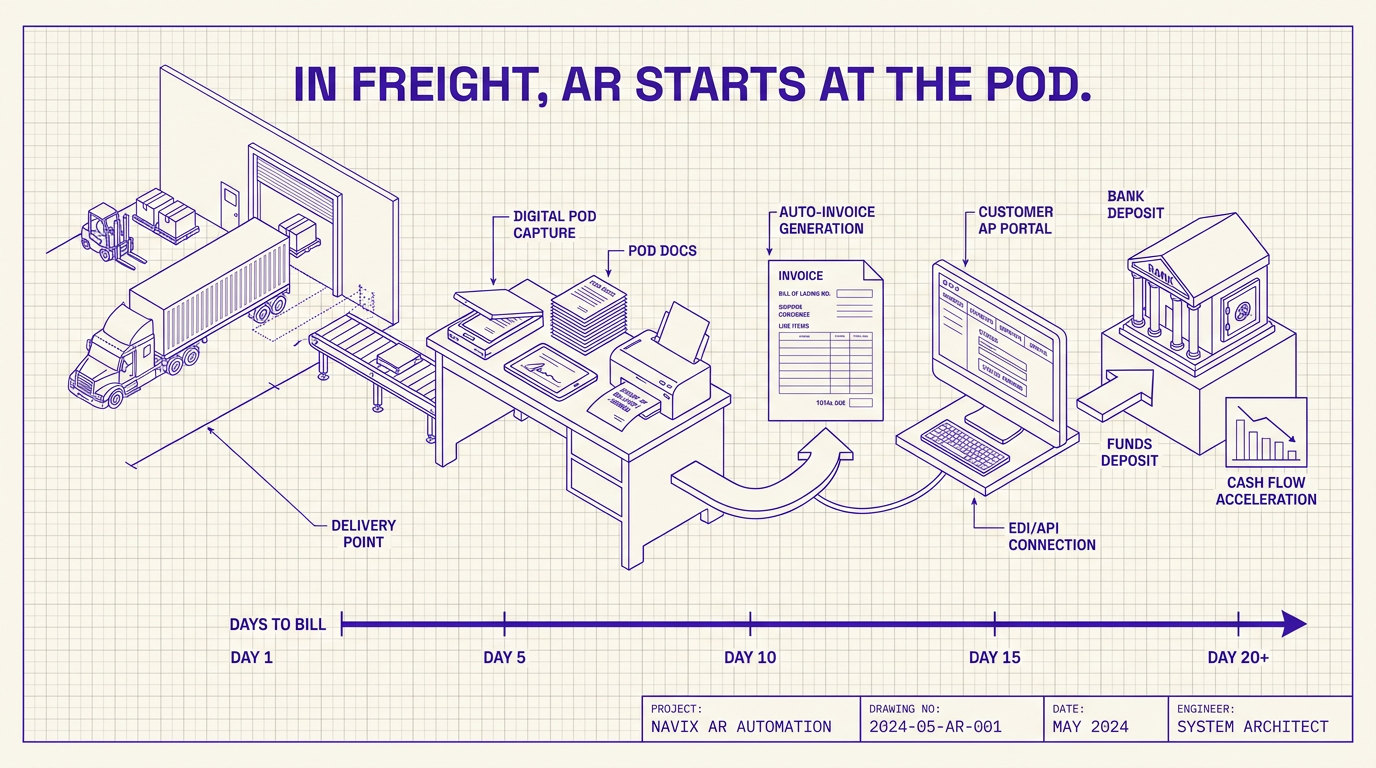
Six stages, with the compression points marked:
- Delivery confirmation. The load delivers; the POD
is captured from the carrier, the driver app, or the portal.
Automation compresses this from days of chasing to same-day
retrieval. - Carrier invoice audit. The inbound invoice is
validated line by line against the rate confirmation and BOL, so
accessorials and reweighs are settled before they can contaminate the
customer invoice. This is the pre-bill step, and the
Navix freight audit software treats it as
the gate for everything downstream. - Invoice assembly. The customer invoice is generated
from the contracted rate with the POD and supporting documents attached,
in the format the shipper’s AP system expects. - Delivery of the invoice. Sent electronically the
day it is ready, to the right AP contact or portal. Batch weekly
billing dies here; days-to-bill drops to one. - Tracking and follow-up. Aging is watched per
invoice, and follow-up triggers on schedule instead of when someone
remembers. - Deposit and reconciliation. Payment lands and is
matched to the invoice, closing the loop and feeding clean data back
into customer credit decisions.
Automation earns the most in stages 1, 2, and 4. Stage 2 is the one
most AR tools skip: generic invoicing software will happily send a fast,
wrong invoice, and a fast dispute is still a dispute. This is why AR
automation for transportation depends on the audit underneath it, the
same engine evaluated in the
freight
audit software guide.
What changes for the billing
team?
Headcount stops scaling with load count. Axle Logistics reallocated
half its billing team to higher-value work while growing roughly 300%
(case
study), because assembling invoices and chasing PODs stopped being
manual work. The team that remains works exceptions and collections
strategy, which is where human judgment actually pays. How that maps to
a specific operation, brokerage, 3PL, or shipper, is covered under
solutions.
Frequently asked questions
What
is accounts receivable automation for transportation?
It is software that automates invoice assembly, POD attachment,
invoice delivery, and payment tracking for freight transactions. The
transportation-specific part is the dependency on shipment documents and
rate agreements: an AR tool that cannot pull the POD and validate the
rated amount can only automate the sending, not the getting-paid.
What is a good DSO
for a freight brokerage?
Published benchmarks vary too much by customer mix and terms to name
a universal number responsibly. The more useful measure is the gap
between contracted terms and actual payment, plus days-to-bill, since
both are controllable. KCH Transportation moved DSO from 39 to 28 days
by fixing the controllable side: billing clean invoices immediately
after delivery.
Does AR
automation help with disputed freight invoices?
It prevents most of them. Disputes cluster around rate mismatches,
unsupported accessorials, and missing documentation, and a pre-billed
invoice audited against the rate agreement with the POD attached removes
those triggers before the invoice ships. Disputes that still occur
resolve faster because the evidence is already assembled.
Is
customer billing data safe in an AR automation platform?
Require a SOC 2 Type II report and read its scope. Navix is SOC 2
Type II attested against the Security criteria of the AICPA Trust
Services Criteria
(details). Rate
agreements and customer billing records deserve the same diligence as
payment credentials.
Measure one number this week: days from delivery date to invoice-sent
date, averaged across last month’s loads. If it is above two, the
cheapest working capital available is sitting in the billing queue.
Book a Navix demo and
see the delivery-to-deposit flow run on live loads.